
From Oche to Big Fish: The Language of Darts Explained
Follow a 501 leg from oche and visit to bust and checkout, then decode scoring, famous finishes, match language and format-specific slang.
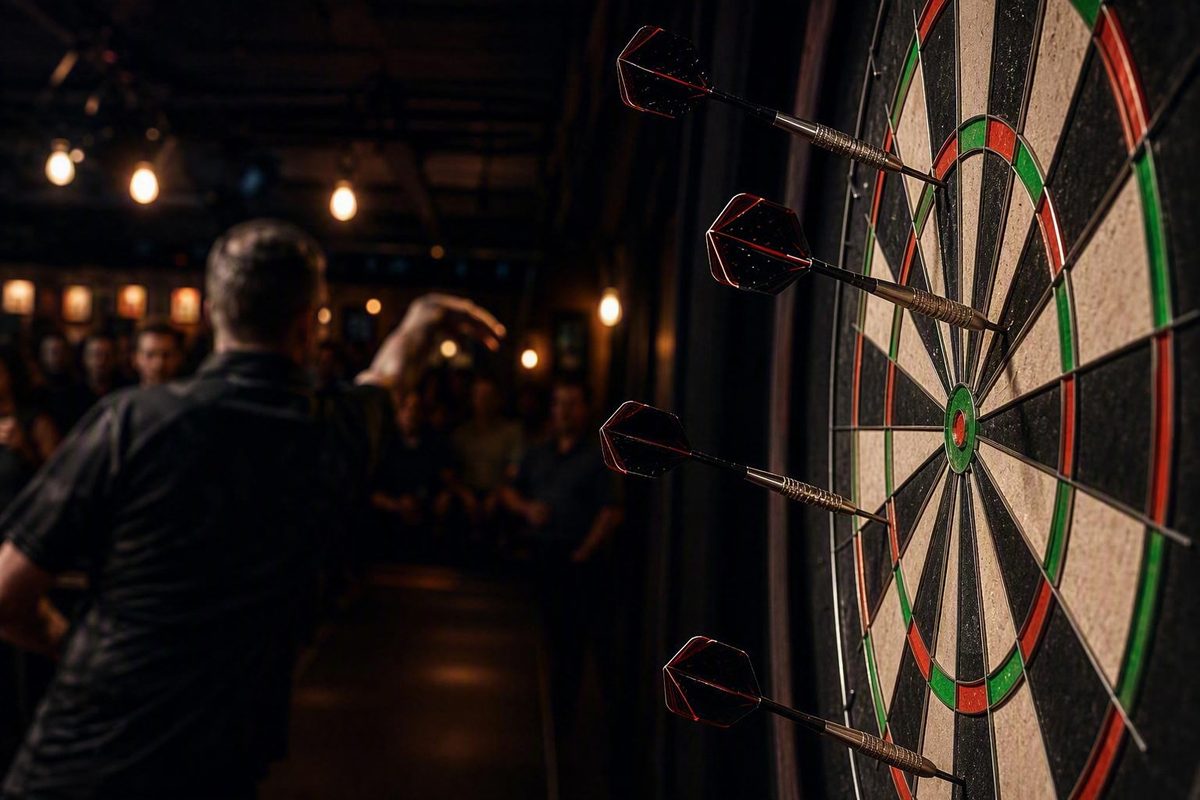
Most darts terms make sense when you follow the flow of a leg: stand at the oche, take a three-dart visit, subtract the score, avoid a bust, and complete a checkout on a double. This guide uses standard double-out 501 as its main reference point; terminology and rules can differ in Cricket, double-in games, soft-tip darts, and local formats.
The 20 darts terms every beginner should know
In standard double-out 501, players count down from 501, normally throw up to three darts per visit, and must reach exactly zero with the final scoring dart in a double. A leg is one game, while the number of legs in a set or match depends on the competition format. The inner bull can complete a leg because it counts as double 25 in this format, as outlined in this guide to 501 rules and checkouts.
| Term | Plain-English meaning | Context |
|---|---|---|
| Oche | The line behind which a player throws | General darts |
| Visit | One turn at the board, normally containing up to three darts | General darts |
| Leg | One complete game, commonly one countdown from 501 to zero | Match play |
| Set | A competition-defined group of legs | Format-dependent |
| Match | The overall contest between players or teams | General darts |
| Single | A scoring area worth the segment’s face value | General darts |
| Double | The thin outer ring, worth twice the segment number | General darts; crucial in double-out |
| Treble or triple | The thin inner ring, worth three times the segment number | General darts |
| Outer bull | The ring surrounding the centre bull, worth 25 | Standard board |
| Inner bull | The centre of the board, worth 50 and treated as double 25 | Standard board and double-out |
| Checkout | A finishable total, finishing route, winning visit, or the act of finishing | Mainly x01 |
| Double-in | A rule under which scoring begins only after a double is hit | Format-dependent |
| Double-out | A rule requiring the final dart to reach zero by hitting a double | Standard 501 reference |
| Bust | An invalid finishing visit that restores the pre-visit score | Mainly double-out x01 |
| Bogey | A remaining total that cannot be finished with the available darts | Mainly x01 |
| Average | Points scored per three darts | Performance statistic |
| Maximum | A score of 180 from three treble 20s | Standard scoring |
| Nine-darter | A 501 leg completed in nine darts, the minimum possible | 501 |
| Hold of throw | Winning a leg after throwing first | Match commentary |
| Break of throw | Winning a leg after the opponent threw first | Match commentary |
An average normally means points scored per three darts. PPD, or points per dart, expresses scoring rate on a one-dart basis; both definitions appear in the broader glossary of darts terminology. For calculation and benchmarking detail, see the Dartboard Stats guide to three-dart averages.
Parts of a dart, dartboard, and playing area
A conventional dart has four principal parts, from front to back:
- Point: The tip that contacts or enters the board.
- Barrel: The main weighted body and the section normally gripped.
- Shaft or stem: The component fitted behind the barrel.
- Flight: The fins at the rear that help stabilise the dart in the air.
On the board, a bed is a particular scoring area, such as the treble 20 bed or double 16 bed. The spider is the wire assembly that separates the board’s segments and rings. These components and scoring areas are illustrated in the BBC’s beginner’s guide to darts jargon.
Within each numbered segment:
- A single scores the displayed number.
- A double scores twice that number.
- A treble or triple scores three times that number.
Single 20 therefore scores 20, double 20 scores 40, and treble 20 scores 60. At the centre of a standard board, the outer bull scores 25 and the inner bull scores 50.
The oche is the throw line, also called the toe line or throwing line. It is commonly pronounced approximately like “hockey.”
A bounce-out is a dart that strikes the board or wire but fails to remain in the board. In standard steel-tip play, it generally scores zero. That qualification matters because an electronic soft-tip machine may register the impact and treat the dart differently under its own settings.
Scoring language: visits, averages, tons, and maximums
A visit is a player’s turn at the board and normally contains up to three darts. A player may use fewer, such as when the first or second dart completes the leg.
Commentators use several shorthand expressions for visit totals:
- Ton: 100.
- Ton-eighty: 180.
- Ton-plus: Broadly, 100 or more, although usage varies.
- Maximum: 180, the highest standard three-dart score.
Treble 20 scores 60, so three darts in that bed produce:
T20 + T20 + T20 = 60 + 60 + 60 = 180
A less successful visit might read:
S20 + S5 + S1 = 20 + 5 + 1 = 26
Here, T means treble and S means single. D means double, so D16 is double 16 and scores 32. These standard scoring terms, including ton, maximum, chalking, and the board-ring values, are collected in the Shot Darts jargon guide.
A maximum score is not the same as a maximum checkout. The only way to score 180 with three standard darts is T20, T20, T20, so the last dart lands in a treble rather than a double. A 180 can build a strong position, but it cannot complete a double-out leg. The highest legal three-dart checkout is 170.
Other useful scoring descriptions include:
-
Chalking: Keeping score, whether on a chalkboard, whiteboard, paper, or another scoring system.
-
Wiring: Landing against or immediately beside a dividing wire, often while narrowly missing a double or treble.
Grouping and wiring describe where the darts land. Neither is a separate scoring category: each dart scores according to the bed legally contacted by its point.
Checkouts, busts, and bogey numbers
A checkout can mean several closely related things:
- A remaining total that can be finished, as in “40 is a checkout.”
- A planned route, such as T20, T20, bull for 170.
- The final scoring visit of a leg.
- The act of completing the leg, as in “She checked out 96.”
In standard double-out 501, the final dart must reduce the score to exactly zero by landing in a double. The inner bull can do this because it is treated as double 25.
Double-in changes the beginning of the leg rather than the finish: the player’s score does not start decreasing until a double is hit. Standard 501 normally allows immediate scoring unless the competition or local rules specify double-in.
Exactly when does a player bust?
A visit busts in standard double-out 501 when it:
- Reduces the remaining score below zero.
- Leaves exactly 1, which cannot be finished with one double.
- Reaches zero without the final dart landing in a valid double.
When any of these happens, the entire visit is void. The score returns to its value at the beginning of that visit, not the total left immediately before the busting dart. The conditions and full-visit reset are explained in this beginner’s guide to the 501 bust rule.
| Starting total | Dart hit | Result | Next score |
|---|---|---|---|
| 32 | T20 | Falls below zero: bust | 32 |
| 20 | S19 | Leaves 1: bust | 20 |
| 20 | S20 | Reaches zero without a double: bust | 20 |
| 40 | D20 | Valid double-out checkout | Leg won |
Suppose a player begins a visit on 32 and hits S16, leaving 16. If the next dart hits T20, the visit busts. The score does not remain at 16; it returns to 32 because both darts from that visit are cancelled.
What is a bogey number?
A three-dart bogey is a remaining total below 170 that cannot be checked out in three darts. The standard list is:
159, 162, 163, 165, 166, 168, and 169
For example, 169 is below the maximum checkout of 170, but no legal sequence of three standard darts can reduce 169 to zero while ending on a double. The player must first reduce it to a finishable total. These recognised bogey numbers are listed in the Darts Corner terminology glossary.
Checkout charts help players avoid awkward leaves by suggesting commonly used routes. They are recommendations, not compulsory combinations.
Famous scores and finishes
Several darts terms describe notable combinations, but they represent different achievements.
180 or maximum: Three treble 20s, producing the highest standard score from a three-dart visit.
Big Fish: The maximum standard three-dart checkout of 170:
T20 + T20 + inner bull = 60 + 60 + 50 = 170
A maximum is a scoring achievement; the Big Fish is a finish. A player can score 180 earlier in a leg without winning it, whereas a successful 170 checkout necessarily ends the leg.
Nine-darter: A 501 leg completed in nine darts, the mathematical minimum. One example is:
- First visit: 180
- Second visit: 180
- Final visit: 141
One route for the final 141 is T20, T19, D12:
60 + 57 + 24 = 141
The three visits total 501, but this is only one possible nine-dart sequence. The definitions of a maximum, a 170 checkout, and a nine-dart finish are also set out in this darts jargon guide.
Shanghai: A single, double, and treble of the same number in one visit, in any order. On the 20 segment:
S20 + T20 + D20 = 20 + 60 + 40 = 120
That is a Shanghai on 20. If it reduces a score from 120 to zero, it may also be called a Shanghai finish.
Two double nicknames are especially useful:
- Tops or double top: Double 20.
- Madhouse: Double 1, the smallest available checkout.
Match terms: bulling up, legs, sets, holds, and breaks
Before a match, players may throw towards the bull to determine who starts. Related names for this procedure include:
- Bull up
- Bull-off
- Cork
- Diddling
- Diddling for the middle
The basic idea is that each side throws towards the bull and the closer dart earns the first throw. Procedures for ties, matching bull areas, measurements, or rethrows can differ, so unusual cases should be resolved under the applicable competition rules. Diddling and cork are both used for the starting procedure in this guide to 501 match play.
Once play begins, the structure is described at three levels:
- A leg is one game, commonly one countdown from 501 to zero.
- A set is a competition-defined group of legs.
- A match is the overall contest.
There is no universal number of legs in a set or sets in a match. Some competitions decide matches entirely by legs, while others group legs into sets.
The player who starts a leg is said to have the throw. That produces two important commentary terms:
| Scenario | Result |
|---|---|
| Player A starts the leg and wins it | Player A holds throw |
| Player A starts, but Player B wins | Player B breaks throw |
A hold of throw means winning after throwing first. A break of throw means winning after the opponent threw first. The language reflects the practical advantage associated with starting, but it does not mean the starting player is guaranteed to win.
Common darts slang heard in pubs and commentary
Slang, not universal rules language: These expressions vary by region, era, commentator, league, and playing community. Players may use different nicknames—or none at all—for the same score or situation.
Arrows or sticks: Informal names for darts. “Good arrows” can also be used as praise after a strong visit.
Bed and breakfast: A score of 26, commonly made with S20, S5, and S1. The 1 and 5 segments sit beside 20, making this a familiar result when darts intended for the top of the board drift sideways.
Champagne breakfast: T20, T5, and T1:
60 + 15 + 3 = 78
Baby ton: A score of 95, five points short of a conventional ton.
Bag of nails: Three darts in single 1:
S1 + S1 + S1 = 3
Bail-out: Recovering a poor visit with a high-scoring final dart. After S1 and S5, for example, a final T20 changes a six-point start into a score of 66.
These score names and combinations—including baby ton, bag of nails, bail-out, bed and breakfast, and champagne breakfast—are catalogued in the Darts Corner glossary of darts slang.
Lipstick: A nickname commonly applied to the treble 20 bed. Usage varies, and some communities may apply it more broadly to a red double or treble.
Fat 20, fat 19, or another “fat” number: The large single area of that numbered segment. A player aiming for fat 20 wants a safe single rather than the treble.
Robin Hood: This does not automatically create a score. The incoming dart’s point must legally contact the scoring board under the applicable rules; merely sticking into another dart is not enough.
Their current playing meanings are more useful than treating pub folklore as established history.
Terms that change by game or dart format
Many finishing terms in this guide assume standard double-out 501. They do not automatically apply to every countdown game, Cricket match, electronic board, or local pub format.
301
301 is another x01 countdown game. Players begin at 301 rather than 501 and subtract their scores as they work towards zero.
Entry and finishing requirements depend on the chosen ruleset. A game may be straight-in, double-in, double-out, or use another agreed combination. The name “301” alone does not establish those conditions.
Cricket
In a common form of Cricket, players target 15 through 20 and the bull. Hits are recorded as marks:
- A single counts as one mark.
- A double counts as two marks.
- A treble counts as three marks.
Players typically need three marks to close a number. Scoring opportunities then depend on which numbers each player has closed. Terms such as checkout, bogey, and double-out are not central in the same way as they are in 501.
Around the Clock
Around the Clock, also called Round the Clock, requires players to hit board numbers in an agreed sequence, usually 1 through 20. Some versions finish at 20; others add the outer bull, inner bull, or a general bull target. The sequence should be agreed before play. These beginner-level distinctions among 501, Cricket, and Around the Clock are summarised in this guide to darts scoring and formats.
Steel-tip and soft-tip darts
Steel-tip darts have metal points and are used with bristle boards.
Soft-tip darts have plastic points and are used with electronic boards containing perforated segments. These machines commonly register and calculate scores automatically.
The equipment difference can affect both rules and terminology. A steel-tip dart that fails to remain in the board generally scores zero. In soft-tip play, a machine may count a registered impact even if the dart later falls, but this is not universal. Bull values, bounce-out treatment, dart-weight limits, and other settings can vary by machine, league, or event, as explained in this steel-tip and soft-tip comparison.
| Format | What changes | Terms to watch |
|---|---|---|
| Standard double-out 501 | Start at 501; reach zero with a final double | Checkout, bust, bogey, double-out |
| Double-in play | Scoring begins only after a double | Double-in, opening double |
| Cricket | Targets and marks replace the x01 countdown | Marks, close, open number |
| Steel-tip | Metal points and a bristle board; non-sticking darts generally score zero | Bounce-out, chalking, spider |
| Soft-tip | Plastic points, electronic scoring, and machine-dependent settings | Registered dart, bull setting, bounce-out |
A beginner who understands the oche, visit, scoring rings, bust rule, checkout, leg, hold, break, 180, and 170 can follow most standard 501 play. Slang and soft-tip rules are less consistent, so follow the language and settings used by the players, machine, league, or competition in front of you. To start measuring your own scoring, move on to the Dartboard Stats guide to calculating and interpreting a three-dart average.