
How to Choose a Sisal Board That Suits the Way You Play
Bristle usually means compressed sisal for steel-tip darts. Compare the full spider, removable number ring, dimensions, mounting and total setup cost.
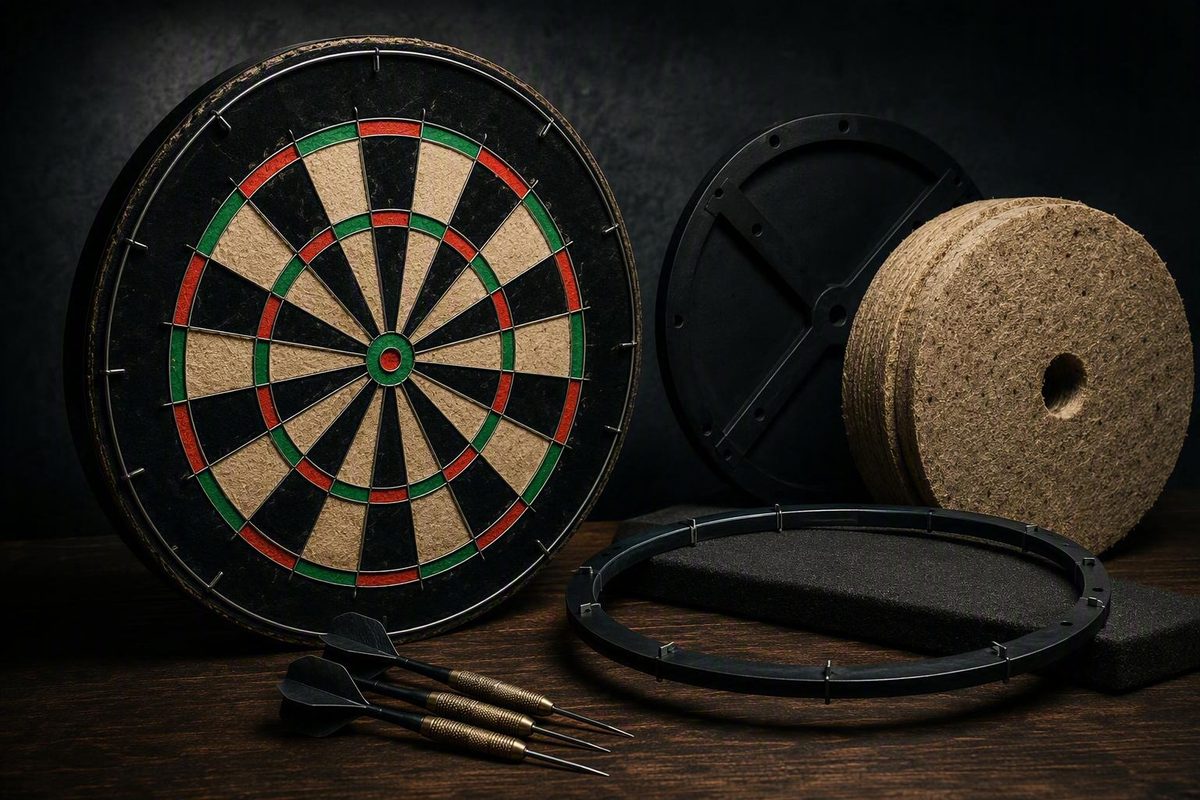
A modern dartboard described as bristle generally has a playing surface made from tightly compressed natural sisal fibers and is intended primarily for steel-tip darts. That definition is simple; choosing between boards is not.
Retail listings often emphasize phrases such as professional, premium sisal or tournament quality. Those labels are less useful than details you can inspect: the stated material, complete wire profile, removable number ring, board dimensions, included mounting equipment and intended dart type. Cabinets, lights and scoring systems affect convenience and total cost, but they do not prove that the board itself is better.
This guide explains how to evaluate a bristle dartboard listing without relying on unsupported rankings or marketing superlatives.
What does bristle mean on a dartboard?
Modern products sold as bristle dartboards are generally made from tightly compressed natural sisal fibers. The playing surface is not normally made from animal bristles, horsehair or cork. Bristle dartboard remains common industry terminology even though sisal board is a more literal description of the material.
Sisal is a plant fiber. Manufacturers compress bundles of it into a dense circular playing face that accepts pointed darts. GLD Products identifies natural sisal—not horsehair or cork—as the material used in these boards and associates it with steel-tip play. GLD Products explains the material used in sisal dartboards.
You will often see sisal described as self-healing. Treat that phrase as shorthand, not a promise of complete repair. When a dart enters the board, it separates or displaces fibers. After the dart is removed, some fibers may settle back together, making an ordinary entry point less noticeable.
A sisal bristle board is primarily associated with steel-tip darts. Do not assume every model also accepts soft tips. Some individual products may claim compatibility with both, but that is model-specific and should be confirmed in the manufacturer’s instructions. If your priority is soft-tip play or automatic scoring through a perforated target, an electronic board may be the more appropriate category.
Dartboard terminology
- Bristle board: The conventional industry name for a compressed-fiber dartboard, normally made from sisal.
- Sisal board: A material-specific name for a modern bristle dartboard.
- Spider: The metal wiring that separates the scoring segments.
- Number ring: The numbered outer ring, ideally removable so the board can be rotated.
- Bullseye: The central scoring area, comprising the inner and outer bull.
- Staple-free construction: A wire arrangement that is embedded, recessed or flush without visible staples or retaining rings in the area being described.
The key buying lesson is that bristle is a product category, not a complete specification. Confirm that the individual listing explicitly states sisal construction rather than inferring it from photographs or category placement.
The construction features that matter most
Start with the playing material. A useful listing should explicitly state sisal, natural sisal fibers or an equivalent bristle construction suitable for steel-tip darts.
Next, examine the spider: the metal dividers that define the singles, doubles, trebles and bull areas. The shape and position of this wiring affect how much of the playing surface remains exposed.
Some boards use raised, round wire secured to the face with visible staples or rings. Thinner, flush, recessed or blade-style wiring presents a smaller or less prominent obstruction. A dart that contacts a slim, angled divider may have a better chance of deflecting into the board than one that strikes a thick raised wire directly.
That makes thin or recessed wiring a sensible feature to prefer, but it does not eliminate bounce-outs. Retailers claim that upgraded wiring can reduce wire-related bounce-outs, but the supplied evidence contains no controlled comparison quantifying the improvement.
Staple-free usually means the spider is recessed or embedded rather than mounted conspicuously above the playing face. Visual signs include wiring that lies flat against the sisal and no visible attachment staples or retaining rings around the relevant segments. Dartshopper explains how recessed wiring differs from raised wire secured with visible rings or staples.
Read the exact wording carefully. A staple-free bullseye is a narrower claim than a fully recessed or staple-free spider. Inspect clear front-facing images of the doubles, trebles and all segment boundaries before concluding that the same construction extends across the complete playing face.
A removable number ring is another practical priority. Players repeatedly target areas such as treble 20, which causes uneven wear. With a removable ring, you can rotate the board, move a less-used section of sisal into the top position and then refit the ring so 20 is once again at the top. This spreads concentrated impacts across more of the playing surface without changing the scoring layout.
Be cautious with descriptions such as:
- premium sisal;
- dense or high-density sisal;
- professional;
- competition board;
- tournament quality;
- advanced player board.
These terms may describe the seller’s intended market, but the supplied evidence does not demonstrate a common grading system behind them. Unless a listing provides a measurable specification or an independently verifiable credential, treat the wording as marketing rather than a technical grade.
The same principle applies to regulation-style, official size and competition approved. Check the listed dimensions against the requirements for your intended play. If a seller claims approval or official use by the PDC, WDF or another organization, verify that claim with the relevant governing body or manufacturer rather than assuming professional wording proves certification. Specialist “professional” collections may include conventional competition-style products alongside licensed or themed designs, illustrating why category placement alone is insufficient. Darts Corner’s professional-board collection demonstrates the breadth of products grouped under that label.
In short, prioritize what you can verify:
- explicitly stated sisal construction;
- steel-tip suitability;
- a clear view of the complete spider;
- minimal exposed wire and attachment hardware;
- a removable number ring;
- suitable dimensions;
- credible mounting and warranty information.
Standalone boards, starter sets, cabinets and scoring systems
Bristle dartboards are sold in several formats. The right one depends as much on the room and installation as on playing level.
A standalone board gives you the most control over the central purchase. The tradeoff is that you may need to buy steel-tip darts, mounting hardware, wall protection, lighting and scoring tools separately.
A starter set packages some of those essentials together. Depending on the listing, it may include darts, a scoreboard or scoring kit, mounting components and basic instructions. This can simplify a first installation, but bundled accessories should not distract from a vague material description, fixed number ring or obstructive wiring.
A cabinet set frames the board behind closing doors. Cabinets can conceal the board when it is not in use, provide a finished appearance and carry score panels on the inside of the doors. They can also increase the installation footprint and constrain your choice of board. Most importantly, an attractive cabinet says nothing by itself about the quality of the sisal board inside.
An illuminated package adds integrated or bundled lighting. Check whether the light obstructs access to the number ring or complicates board rotation.
An accuracy-training board is a specialist tool. Some models use narrower doubles and trebles or a smaller bull area to demand greater precision. This can be useful for focused practice, but it is not a like-for-like substitute for a conventional scoring layout. A player preparing for ordinary match conditions will still need time on the standard target format.
An automatic-scoring bristle system combines a conventional-style fiber surface with cameras, sensors, software or connected scoring equipment. In one retailer snapshot, conventional boards started below $30 while a dedicated automatic-scoring system was displayed at $1,199.99. Escalade Sports’ collection illustrates the range from basic boards and cabinet sets to connected scoring systems.
| Use case | Best starting format | Features to prioritize | Likely extras or tradeoffs |
|---|---|---|---|
| First home setup | Starter set or standalone board | Genuine sisal, steel-tip suitability, removable ring, clear mounting instructions | A bundle is convenient; a standalone choice may direct more of the budget toward the board |
| Frequent solo practice | Standalone board with wall surround | Slim or recessed wire, easy rotation, secure mounting, appropriate lighting | Darts and scoring tools may need to be purchased separately |
| League-style practice | Conventional competition-format board | Dimensions required by the league, complete wire design, verifiable credentials where necessary | Do not assume “professional” means approved |
| Accuracy training | Specialist training board | Reduced target areas suited to the intended drill | Not a direct replacement for a normal scoring layout |
| Finished game room | Cabinet, or standalone board with separate surround and lighting | Neat installation, wall protection, access for rotation | Cabinets add bulk and do not guarantee board quality |
| Technology-assisted scoring | Conventional board with an app or manual tools, or a dedicated automatic system | Scoring workflow, installation requirements, support and replacement options | Dedicated systems can be substantially more expensive |
Before choosing a format, calculate the total installed setup, not just the board price. Conversely, a large bundle can be poor value if the core board specification is unclear.
What should a bristle dartboard cost?
The figures below are retailer snapshots reviewed on September 7, 2026, not permanent market ranges. Prices, sales, availability, bundle contents and sellers can change. The sources display dollar signs, but retailer locale and currency presentation should be confirmed before comparing products; the figures below have not been converted or normalized between stores.
Across the supplied marketplace and specialist-retailer listings, approximately $28 to $60 as displayed represents an observed entry-level area. Listings in this range included basic standalone boards and starter sets, sometimes with steel-tip darts, a scoring kit or scoreboard. This is an orientation range rather than a universal minimum or maximum. Walmart’s snapshot included relevant listings at $27.99, $32.46, $49.99 and $59.99.
Approximately $60 to $100 as displayed formed a practical middle area in the reviewed listings. Buyers encountered conventional boards, competition-style products and some cabinet packages in this band. Price alone did not establish better sisal, lower bounce-out rates or longer life; the spider, ring, material statement and bundle contents still required comparison. Escalade’s snapshot, for example, displayed boards and cabinet sets at prices including $69.98, $85.99 and $99.99.
Several premium standalone listings fell around $100 to $145 as displayed. At this level, sellers commonly emphasized advanced wire profiles, branded mounting systems, layered construction or professional positioning. Those details may matter, but the supplied sources do not contain standardized testing showing how much additional durability or dart retention the higher price buys. Darts Corner’s snapshot included premium-positioned standalone boards reaching $145.
Automatic scoring changes the comparison even more: the reviewed Escalade assortment included a dedicated automatic-scoring bristle system displayed above $1,000, alongside much less expensive conventional products. That spread shows why format must be normalized before headline prices are compared; it does not show that the most expensive product has the best playing surface.
Use this value test:
- Material: Does the listing explicitly say sisal?
- Dart type: Is steel-tip suitability clear?
- Complete wire design: Is the entire spider shown and described, not merely the bull?
- Wear management: Is the number ring removable?
- Essentials: Which included darts, mounts, scoreboards or surrounds are genuinely useful?
- Seller: Is the seller identifiable, with clear return arrangements?
- Warranty: Are the term, coverage and claim procedure stated?
- Replacement options: Can the board or system components be replaced separately?
- Installed cost: What else must you buy before you can play comfortably?
Do not treat high ratings, sparse reviews, best-seller badges or sale labels as independent evidence of durability. They may reveal recurring buyer complaints, but they do not replace controlled comparisons of sisal density, wear, dart retention or bounce-outs.
A practical bristle dartboard buying checklist
Use the following checklist on every product page, particularly when shopping through a broad marketplace.
- [ ] The material is stated explicitly. Look for natural sisal fibers or clear sisal bristle construction.
- [ ] Steel-tip suitability is confirmed. Do not infer dart compatibility from the board’s appearance.
- [ ] The full front of the board is visible. You should be able to inspect the doubles, trebles, bull and segment dividers.
- [ ] The spider profile is described or clearly shown. Prefer thinner, flush, recessed or blade-style wiring over bulky raised round wire where the budget permits.
- [ ] Visible attachment hardware is checked. Look for staples or rings around all scoring areas, not only the bullseye.
- [ ] “Staple-free” has a defined scope. Confirm whether it applies to the complete spider or only the bull.
- [ ] The number ring is removable. A rotatable board makes uneven wear easier to manage.
- [ ] Dimensions suit the intended play. Compare the manufacturer’s figures with the requirements of your home setup or league.
- [ ] Mounting information is clear. Identify what hardware is supplied and whether leveling or spacing components are needed.
- [ ] Extras are separated from essentials. Darts, cabinets, chalkboards, lights and scoring tools can add convenience but do not prove board quality.
- [ ] Seller identity and terms are visible. Check return conditions, warranty information, current stock and who handles a problem.
- [ ] Replacement options are practical. This is especially important for cabinets, lighting and automatic-scoring systems.
- [ ] Official-use claims can be verified independently. Check claimed PDC, WDF or league approval with the relevant organization.
- [ ] The total setup cost is understood. Include wall protection, lighting, darts, mounting and scoring.
Marketplace categories require extra care. A page labeled “bristle dartboards” can contain magnetic targets, electronic boards, paper-wound boards, children’s products, cabinets without boards and other unrelated items. Walmart’s category snapshot mixed relevant bristle listings with magnetic and other targets, demonstrating why a category label is not proof of sisal construction.
Treat words such as professional, competition, premium, high-density and tournament quality as prompts for further questions:
- What material is used?
- Is the claimed density measured?
- What exactly differs about the wire?
- Is the ring removable?
- Which dimensions are specified?
- Who granted any claimed approval?
- Is there a warranty appropriate to the price?
Red flags include:
- no material stated;
- no clear, straight-on image of the board;
- a marketplace category used as the only evidence that the board is bristle;
- vague steel-tip or soft-tip compatibility;
- claims that every hole repairs completely;
- “staple-free bull” presented as if it describes the entire spider;
- accessories emphasized while board construction is omitted;
- professional or tournament claims without supporting specifications;
- no identifiable seller, return terms or warranty details.
For most beginners, a sensible minimum viable specification is straightforward: genuine sisal, confirmed steel-tip suitability, a removable number ring and wiring that does not unnecessarily obstruct the scoring areas. Once those basics are secure, compare accessories, finish and appearance.
Choosing by player and room type
Different buyers should allocate their budgets differently. There is no single format that is automatically right for a first-time player, a league regular and a game-room owner.
Beginners should prioritize a real sisal surface, steel-tip suitability, a removable number ring, usable wiring and clear mounting instructions. A set that includes darts can be convenient, but six basic darts do not compensate for a fixed ring or an unclear board material. Start with a sound playing surface; upgrade darts and accessories later if needed.
Frequent home players benefit more from wear-management features. A removable ring is particularly valuable when the board receives regular concentrated practice. Plan an indoor, dry location where the board can remain securely mounted and be rotated without dismantling the entire setup.
League-oriented players should reproduce the conditions their league actually requires. Check board dimensions, layout and equipment rules directly rather than buying something because its title includes professional. If approval or official-use status matters, confirm the credential independently.
Accuracy-focused players may benefit from a specialist training board with narrower doubles, trebles or bull areas. Match preparation still calls for the target sizes and visual references used in the relevant competition.
Game-room buyers often value appearance and storage. A cabinet conceals the board, creates a framed installation and may supply score panels. Lighting can be added to either arrangement, but check that it allows access to the number ring and does not create distracting shadows.
Technology-focused buyers should distinguish between two routes. A dedicated automatic-scoring bristle system integrates more of the process but introduces hardware, software and support dependencies. Compare calibration, subscriptions if any, component replacement and room requirements—not merely the board face.
No definitive best brand or model can be named from the available evidence. The sources are dominated by retailers and affiliate content rather than standardized independent comparisons of sisal density, durability, dart retention or bounce-out rates. A confident ranking would imply certainty the evidence does not provide.
Use this decision sequence instead:
- Choose the play type: casual steel-tip, frequent practice, league preparation, accuracy training or technology-assisted play.
- Confirm the material and dart compatibility: explicit sisal construction and steel-tip suitability come first.
- Inspect the wiring and ring: evaluate the complete spider, visible staples and whether the number ring can be removed.
- Choose the installation format: standalone, starter bundle, cabinet, illuminated package or automatic-scoring system.
- Compare total cost: include every component required to install, protect, light and score the setup.
This approach is less dramatic than accepting a retailer’s “best board” claim, but it is more likely to produce a board that fits how and where you play.
How to care for a sisal bristle board
A board does not wear evenly. Treble 20 and the surrounding 20 segment receive concentrated traffic, while 19 and other preferred scoring routes may also accumulate more impacts than rarely targeted areas. Rotation distributes that load across different sections of sisal.
To rotate a board:
- Remove the external number ring.
- Release or adjust the board as required by its mounting system.
- Rotate the playing face so a less-used segment occupies the heavily targeted top position.
- Secure and level the board again.
- Refit the number ring with 20 correctly positioned at the top.
Rotation frequency should follow actual use and visible wear rather than a universal calendar. Darts Corner suggests roughly weekly rotation for someone playing one to two hours a day and about monthly rotation for one to two hours of weekly play. These are practical reference points, not mandatory intervals. Darts Corner provides the usage-based rotation examples and recommends distributing wear away from heavily targeted segments.
Inspect the playing face when deciding whether to rotate. If one scoring area is becoming visibly rough or compacted while others remain comparatively fresh, rotate sooner. A player who repeatedly practices one double may create a different wear pattern from someone who focuses mainly on treble 20.
Keep the board indoors and dry, away from direct sunlight, damp walls and excessive heat. Avoid exposed outdoor areas, humid storage spaces and places where the board could be splashed. A cabinet can shield the face from light and dust when closed, but it cannot correct an unsuitable room environment.
For routine cleaning, begin with conservative dry methods:
- wipe lightly with a clean, dry microfiber cloth;
- use a lint roller to collect loose fibers;
- use a handheld vacuum on low suction without pressing it into the surface.
IgnatGames recommends a dry microfiber cloth or low-suction handheld vacuum and advises keeping water, polish and harsh liquids away from sisal. Its cleaning guide describes these dry-cleaning methods.
Commercial guidance differs slightly on moisture. Some retailer care guides advise avoiding water, while GLD Products permits a slightly damp—not wet—towel when cleaning is unavoidable. The cautious approach is to use dry methods first and introduce moisture only if the instructions for your specific model expressly permit it. Do not assume that guidance for one board’s fibers, adhesive and backing applies to every other model.
Avoid soaking, spraying or steaming the board. Do not apply polish, white petrol or harsh cleaning liquids.
Inspect steel points periodically. GLD Products recommends keeping points rounded and free from burrs and removing darts with a gentle twist. Do not leave darts embedded after play.
Maintenance can distribute wear and help avoid preventable damage, but it cannot make a sisal board permanent or reverse severe swelling, warping, cuts or concentrated wear. If deterioration begins to affect play or installation, consult the manufacturer’s model-specific care and replacement guidance rather than relying on a universal lifespan or replacement threshold.
A sensible care routine is simple: rotate according to use, keep the board dry and shaded, clean it gently, maintain smooth points and remove darts carefully.
Frequently asked questions
Are bristle and sisal dartboards the same thing?
Usually, yes. In modern retail terminology, a bristle dartboard generally means a board made from tightly compressed natural sisal fibers. Bristle is the established category name; sisal identifies the plant-fiber playing material. Still, verify the material in the individual listing because category labels can be applied loosely.
Can I use soft-tip darts on a bristle dartboard?
Do not assume so. Sisal bristle boards are primarily associated with steel-tip darts. Some individual models may be advertised for both steel and soft tips, but compatibility is not universal. Check the manufacturer’s instructions for the exact board and dart points you intend to use.
Does a staple-free dartboard prevent all bounce-outs?
No. Recessed, flush or thinner wiring reduces the amount of prominent metal in the scoring area and may reduce wire-related bounce-outs, but it cannot prevent all of them. The available retailer guidance does not quantify the reduction.
How often should I rotate a bristle dartboard?
Base rotation on playing frequency and visible wear. As a rough guide, retailer care advice suggests about weekly rotation for one to two hours of daily play and about monthly rotation for one to two hours of weekly play. Rotate sooner if a heavily targeted segment is wearing noticeably faster. Always refit the number ring with 20 at the top.
Can I clean a sisal dartboard with water?
Dry cleaning is the safer default. Use a dry microfiber cloth, lint roller or low-suction handheld vacuum without pressing into the surface. Some care guidance advises avoiding water entirely, while one retailer permits a barely damp towel when cleaning is unavoidable. Use moisture only if the manufacturer of your specific board expressly allows it, and never soak, spray or steam the sisal.
Ultimately, bristle usually means compressed sisal. The soundest buying decision comes from verifying that material, confirming steel-tip suitability, inspecting the complete wire design, checking for a removable number ring and comparing installation format and total setup cost. Ignore unsupported superlatives, verify compatibility and competition claims independently, and protect the board through rotation, dry storage, gentle cleaning, smooth points and careful dart removal.