
How to Choose and Look After a Sisal Dartboard
Learn how sisal construction, wiring, mounting, rotation and care affect play and wear, plus what to check before buying a steel-tip board.
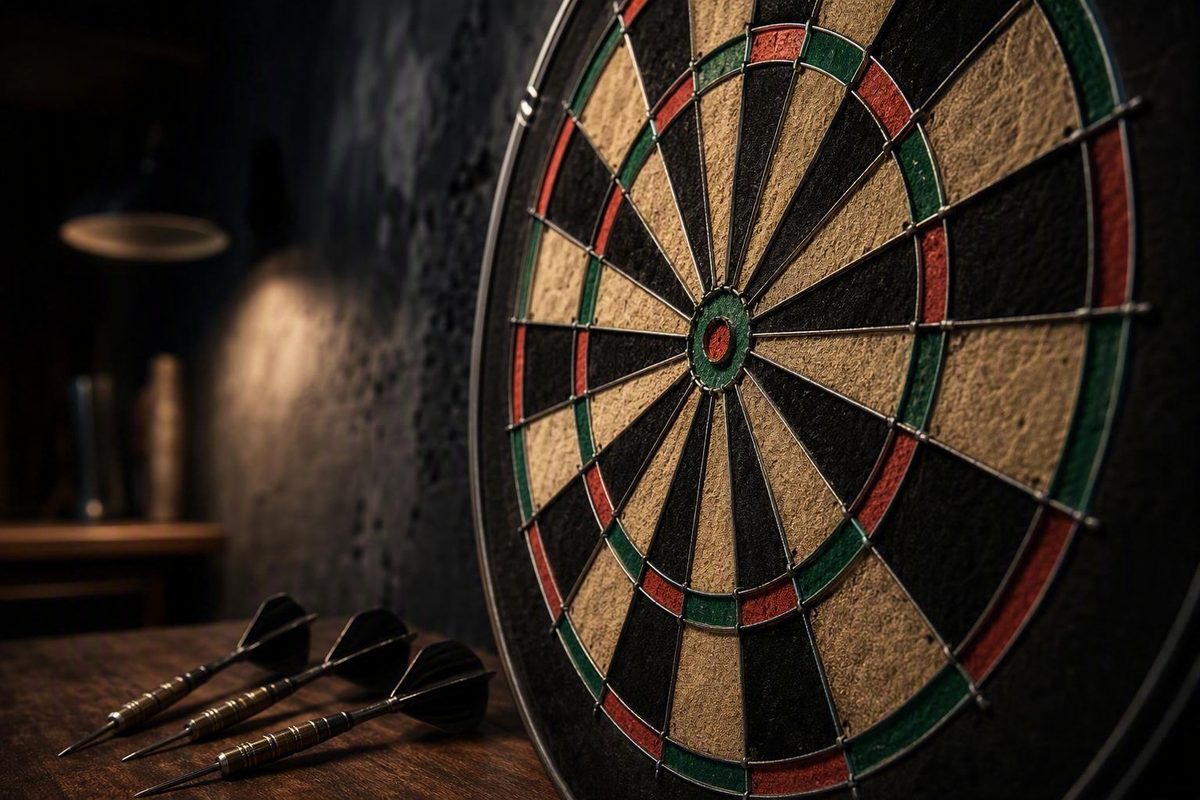
A bristle board dartboard is the traditional target used with steel-tip darts. Despite the established name, modern versions are generally made from tightly compressed sisal fibers rather than literal bristles. Sisal construction, wiring, rotation, mounting, and care all influence how a board plays and wears.
The right choice is rarely the model with the most ambitious label. Start with who will play, where the board will go, and whether you want traditional steel-tip play or automatic scoring. Then compare format, dimensions, wire profile, number ring, mounting arrangement, package contents, space requirements, and total setup cost.
Editorial note: This guide synthesizes the supplied manufacturer and retailer documentation reviewed on September 5, 2026. Named products illustrate market variety and were not independently tested or ranked. Commercial performance claims are treated as claims rather than established results.
What a bristle board dartboard actually is
“Bristle dartboard” is the established market term. A modern bristle board normally has a circular playing surface made by compressing natural sisal fibers into a dense target suitable for steel points. Some manufacturers prefer the more precise term “sisal dartboard,” but both names are commonly used. GLD Products’ sisal dartboard maintenance guide identifies natural sisal—not cork, horsehair, or literal bristles—as the playing material.
A typical board has several main parts:
- Sisal playing face: the compressed fiber surface into which steel points enter.
- Spider: the metal divider separating the numbered wedges and the singles, doubles, trebles, and central scoring areas.
- Bullseye: the two-part center target, consisting of an outer and inner bull.
- Numbered segments: the wedge-shaped scoring sections around the face.
- Number ring: the outer ring showing the value assigned to each wedge.
- Backing: the rear structure supporting the playing face.
- Mounting system: commonly a rear center screw and wall bracket, although other arrangements exist.
- Stabilizers: feet, pads, or adjustment points that may help prevent rocking against the wall.
These boards are primarily intended for steel-tip darts. When a listing describes sisal as “self-healing,” read that as shorthand rather than literal regeneration. The compressed fibers can partly close after a dart is removed, but the face does not return to factory-new condition. Point marks, loose fibers, fading, hard areas, and concentrated wear can still accumulate.
Construction varies substantially. Two boards may both use sisal yet differ in wire thickness and shape, bullseye construction, number-ring design, backing, and mounting stability. Thin or embedded wiring, a staple-free bull, and a removable number ring are useful features to investigate, but they are not present on every board.
Package contents also vary. One model may include a bracket and fixing components, while another is sold as the board alone.
In practical terms, “bristle board” identifies the broad product category. It does not guarantee a particular size, wire system, bull design, mounting kit, or set of accessories.
Is a bristle board the right type for you?
Choose by intended players, dart type, scoring preference, available room, and desired playing experience. A sisal board is a natural fit for traditional steel-tip practice, but it is not automatically the right choice for every household.
Sisal bristle versus electronic
A traditional sisal board is designed primarily for steel-tip darts. Scoring is ordinarily handled mentally, on a scoreboard, or through a separate app. This format suits players who want a familiar pub, club, league, or match-style setup.
Electronic boards generally use soft-tip darts and commonly calculate scores automatically. The basic distinction is steel tips and normally manual scoring on a classic sisal board versus soft tips and commonly automatic scoring on an electronic board (Dartshopper).
A camera, sensor, app, or connected scoring system can add automation to some bristle setups. This preserves a sisal playing face while reducing manual scorekeeping, but it also increases price and setup complexity. Automated scoring is an accessory or surrounding system; it is not what makes the board a bristle board.
Sisal bristle versus magnetic
They are mainly positioned as introductory or recreational products for children, families, and casual beginners. They do not closely reproduce conventional steel-tip practice, so they are not direct substitutes for someone preparing for steel-tip league play (GLD Products).
Their main appeal is accessibility. Household supervision and a clear playing area still matter, even though the darts and target work differently from a traditional steel-tip setup.
Sisal bristle versus cork
Cork is a distinct natural material. Depending on the product, a cork board may use printed or painted scoring boundaries instead of a metal spider. It should not be confused with compressed sisal simply because both materials can accept pointed darts.
The available evidence does not justify broad claims that every cork board is weak or unsuitable. Inspect the individual product’s density, scoring layout, intended dart type, mounting arrangement, and replacement expectations. For conventional steel-tip practice, a standard-format sisal board generally makes comparison with familiar pub and league-style setups more straightforward.
Safety and space
Steel-tip darts present greater wall- and floor-damage risks than soft-tip darts, making the room and its protections part of the buying decision.
Soft-tip and magnetic systems reduce some of the practical concerns associated with penetrating steel points, but the room still needs to support controlled play. A narrow shared space with frequent traffic is a poor match for a traditional steel-tip installation.
Decision matrix
| Use case | Suitable starting point | Why | Main tradeoff |
|---|---|---|---|
| Serious or league-style practice | Standard-format sisal bristle board | Uses steel tips and reproduces traditional play | Requires separate scoring, protection, and maintenance |
| Casual adult home play | Sisal or electronic board | Choose traditional steel-tip play or soft-tip convenience | Room layout and scoring preference determine the better fit |
| Family use with children | Electronic soft-tip or magnetic board | Accessible and less dependent on penetrating steel points | Less representative of traditional steel-tip play |
| Deliberate accuracy training | Standard sisal board or specialized training board | Supports focused practice; reduced targets can increase difficulty | A reduced-target board is not a standard-format substitute |
| Automatic scoring is the priority | Electronic board or connected sisal system | Minimizes manual scorekeeping | Connected sisal systems can be much more expensive |
| Pub or club replacement | Standard sisal board with removable ring and stable mount | Familiar format and easier distribution of wear | High-volume use requires regular inspection and rotation |
The central question is not which board type is universally best. It is which set of compromises matches the players, room, scoring preference, and intended style of play.
The buying features that matter most
A useful comparison begins with verifiable specifications rather than words such as “premium,” “professional,” or “competition-grade.”
Buying checklist
1. Stated dimensions and format
Check the overall diameter, playing-face dimensions, depth, and weight. A retailer may call a product “official size,” but that wording alone does not establish compliance with a governing body’s current dimensions and tolerances. For sanctioned play, verify the applicable rules and any claimed approval directly.
Also establish whether the product is a standard-format board. A training board can look conventional while deliberately using narrower doubles, trebles, or bull areas. That creates a more demanding target but is not a direct dimensional substitute for normal match practice.
2. Sisal construction
Confirm that the playing face is compressed sisal if that is what you intend to buy. Descriptions such as “premium sisal,” origin claims, and layered-core terminology may distinguish product lines, but the supplied evidence does not show that any such phrase guarantees better durability or performance.
Look instead for clear construction details, warranty terms, and a workable returns process.
3. Wire profile
The spider occupies space that would otherwise be playable sisal. Staple-free construction similarly removes staples from particular scoring areas.
That design logic is reasonable, but the supplied commercial evidence does not quantify a reduction in bounce-outs. Treat wire geometry as a practical feature rather than a performance guarantee.
Inspect consistency as well as thickness. A thin wire system is of little benefit if the dividers are visibly displaced, loose, protruding, or poorly aligned.
4. Bullseye construction
Check how the bullseye is divided and secured. Do not assume it is staple-free merely because the overall board is marketed as advanced, tournament-style, or professional.
5. Removable number ring
A removable number ring is one of the most useful ownership features. It allows the physical board to be rotated while the ring is returned to its normal orientation with 20 at the top. This moves frequently targeted numbers onto less-used portions of the sisal and spreads future wear. Darts Corner likewise describes a removable number ring as a means of distributing wear.
Confirm that “rotatable” refers to the playing face and removable ring in practice, not merely to decorative movement.
6. Mounting system
Find out what is supplied and what the installation requires:
- Is there a rear center screw?
- Is a compatible wall bracket included?
- Are stabilizing feet or pads supplied?
- Can the board be leveled after mounting?
- Does the intended wall or backing panel suit the specified fixing method?
- Would a cabinet, stand, or quick-fit mount require different components?
Follow the instructions for the specific board and mounting surface. Do not assume every bracket or fixing component is interchangeable.
7. Warranty and returns
Read the actual coverage rather than assuming that “professional” implies comprehensive protection. Check:
- coverage period;
- exclusions;
- proof-of-purchase requirements;
- responsibility for return shipping; and
- how the seller handles a warped face, displaced spider, missing hardware, or shipping damage.
8. Package contents
Determine whether the listed price buys:
- the board alone;
- a board and bracket;
- steel-tip darts;
- a surround;
- a cabinet;
- lighting;
- a scoreboard;
- an oche marker;
- an app subscription; or
- automatic-scoring hardware.
Base the comparison on the written package inventory.
Training boards need their own comparison
A reduced-target training board intentionally makes key scoring areas smaller. One captured retailer listing, for example, described a model with thinner doubles and trebles and a smaller bullseye (Billiards.com).
That is specialized practice equipment, not evidence of faulty dimensions. An improving player may find reduced targets useful for structured sessions, but a beginner may find them discouraging. A league player may still need a standard board for match-format practice.
Compare training boards with other training boards rather than treating them as interchangeable with standard-format boards at the same price.
Treat status words as claims
“Professional,” “official size,” “competition-grade,” “tournament,” and “approved” are not interchangeable terms. A category name or product title does not establish certification.
If status matters, check current documentation from the manufacturer and the relevant governing body or league. Do not rely solely on retailer copy, badges, marketplace placement, or packaging language.
Inspect the board when it arrives
Before throwing darts, check that:
- the face is flat rather than visibly warped or severely bulged;
- there are no major cracks or separated areas;
- the sisal has no obvious abnormally hard or loose sections;
- the spider is consistently seated and does not protrude;
- the scoring beds are correctly divided;
- the number ring is complete and secure;
- the rear mounting point is sound;
- stabilizers and brackets are not bent;
- all promised hardware and accessories are present; and
- the installed board can sit level without wobbling.
Photograph significant defects before use and retain the packaging until the board has been inspected and mounted successfully.
Board-only, cabinet, training, and connected systems explained
Retail collections often mix fundamentally different products. Sorting them by format prevents misleading comparisons.
Standalone standard board
This is a standard-format sisal board, supplied either alone or with basic mounting components. It offers maximum flexibility because you can choose your own darts, surround, lighting, scoreboard, and mount.
Its apparent simplicity can conceal additional expense. A board-only purchase may still require darts, protection, an oche marker, lighting, and scoring equipment.
Best suited to: buyers who already own accessories or want a tailored installation.
Starter kit
A starter kit combines a board with some of the items needed to begin playing.
Convenience is the main advantage, but “complete” is too vague for comparison. Check:
- how many darts are included;
- whether they are steel-tip;
- their stated weight;
- what mounting components are supplied;
- whether wall protection is included; and
- whether the accessories suit the intended players.
Included darts may be adequate for guests without matching the primary player’s preferred grip, barrel, or weight.
Best suited to: first-time buyers who want a single-box purchase and have verified its contents.
Cabinet set
A cabinet encloses the board visually and normally has doors that close over it. A cabinet can improve a shared room’s appearance and hide the target when it is not being used.
A cabinet is not automatically equivalent to a surround. Nor does “cabinet set” guarantee darts, lighting, appropriate fixing components, or a higher-specification board.
Cabinet depth also affects setup because the throw distance is measured from the playing face. If the cabinet moves that face farther from the wall, the oche must be positioned from the new face location.
Best suited to: game rooms and shared spaces where enclosure and appearance matter.
Training board
A training board has deliberately reduced target areas, usually to make precision practice harder. It may otherwise use sisal and steel-tip darts in the same broad way as a standard board.
This is specialist equipment. Buyers should understand the dimensional difference rather than assuming it is a conventional match board.
Best suited to: experienced or improving players running structured accuracy drills.
Surround
A surround is a protective ring fitted around a board. It is not a dartboard and may not include separate mounting hardware.
Measure compatibility rather than assuming a universal fit. A close-fitting surround also covers only the area immediately around the target, so the complete room still needs to be assessed before installation.
Best suited to: exposed steel-tip installations where added protection around the target is required.
Connected or automatic-scoring system
Some are integrated packages, while others are installed around a separate board.
They can simplify scoring and support connected play.
Best suited to: buyers who specifically value scoring automation and accept the extra cost and technical setup.
These categories explain why retailer listings vary so widely. A low-cost standalone board, cabinet combination, reduced-target training board, and automatic-scoring system perform different jobs and should not be ranked as though they were interchangeable.
Budget by total setup cost, not board price alone
Prices are volatile. Promotions end, stock changes, and models are replaced. The figures below are retailer snapshots reviewed on September 5, 2026, not evergreen prices or recommendations.
The supplied listings placed standalone boards at roughly $30 to $140. Escalade Sports showed the Accudart Classic at $29.99, while cabinet products on the same collection page ranged from the DMI Dublin at $85.99 to the Accudart Standing LED set at $319.99 (Escalade Sports).
A separate retailer snapshot listed the Vector E15 at $59.99, the Unicorn Eclipse Ultra at $129.99, and the Winmau Blade 6 Triple Core at $135. These were asking prices and associated stock labels were time-sensitive, not evidence of product quality or value (Billiards.com).
Connected scoring occupied a much higher price tier. Escalade Sports displayed a Unicorn Smartboard sale price of $359.99 and listed a Prodigy automatic-scoring bristle system at $1,199.99, with the latter marked out of stock at capture. Those discount and availability labels can change (Escalade Sports).
Total-cost checklist
Budget for the complete usable installation:
- Board: standard, training, or connected.
- Steel-tip darts: enough suitable darts for the intended players.
- Mounting: the bracket, rear screw, stabilizers, and any installation components specified for the setup.
- Wall protection: a surround, cabinet, or broader protective panel.
- Floor protection: appropriate to the room and flooring.
- Lighting: enough to illuminate the face without strong glare or heat.
- Oche: tape, a mat, a raised line, or another stable throw-line marker.
- Scoring: a chalkboard, whiteboard, app, display, camera, or sensor system.
- Storage: somewhere to keep the darts out of the playing face between sessions.
- Future replacement: the sisal face is a wear item even when maintained.
- Installation work: potentially necessary for cabinets, backing panels, or unsuitable mounting surfaces.
A lower-priced board plus separate accessories can cost more than a set. Conversely, a set is not automatically better value if its darts, mount, lighting, or cabinet do not suit the intended installation.
Sponsored placement, temporary discounts, stock warnings, bestseller badges, and star ratings do not prove long-term quality.
Compare like with like: board-only against board-only, cabinet set against cabinet set, and connected system against connected system. Then add the cost of anything missing.
How to mount a bristle dartboard and prepare the playing area
Plan the room before drilling. The installation needs enough wall area, an unobstructed throwing lane, room behind the oche for a normal stance, and a stable location for the board.
Common steel-tip measurements
A commonly cited setup uses:
- Bullseye center: 5 feet 8 inches above the floor.
- Horizontal throw distance: 7 feet 9.25 inches from the board face to the oche.
- Diagonal check: 9 feet 7.375 inches from the bullseye to the throw line.
These dimensions are given in GLD Products’ steel-tip dartboard mounting demonstration. The source is a manufacturer demonstration rather than a current governing-body rulebook, so verify the rules that apply to your league or sanctioned event before making permanent marks.
The horizontal distance begins at the playing face, not automatically at the wall. A thick board, backing panel, cabinet, or stand can move the face forward and therefore change the correct position of the oche.
Measure bull height from the finished playing floor. If a mat or raised platform changes the surface on which the player stands, account for that surface consistently.
A typical bracket installation
A common bracket arrangement works as follows:
- Choose the center point. Mark the required position of the bullseye center.
- Locate the bracket. Use the product instructions to determine where the bracket must sit relative to that center point.
- Install the bracket. Follow the supplied mounting instructions for the intended surface.
- Fit the rear mounting screw. Install it in the designated central point on the board’s back.
- Fit stabilizers. Add the supplied feet or pads in their specified positions.
- Seat the board. Lower the rear screw into the bracket.
- Orient the face. Position 20 at the top.
- Level and stabilize it. Adjust the board until it sits flat and does not rock.
- Measure from the face. Place the oche at the required horizontal distance.
- Recheck the setup. Confirm bull height, throw distance, orientation, and stability.
This is one common method, not a universal installation standard. Cabinets, stands, backing panels, and quick-fit systems can use different arrangements. Follow the documentation supplied with the specific board and mount.
Prepare the surrounding area
Wall and floor protection: Steel-tip systems present a greater risk of property damage than soft-tip systems, so choose protection appropriate to the players and room. A close-fitting surround may not cover every likely miss, particularly for beginners (Escalade Sports).
Lighting: Illuminate the whole face evenly while limiting glare and strong shadows. Keep the board away from heat-producing lighting because concentrated heat and direct sunlight can dry fibers and fade the printed face.
Throw line: Use a clear, stable oche marker. Recheck its position periodically, especially if it is part of a movable mat.
Clear lane: Arrange the room so the route between oche and target can remain unobstructed during play and dart retrieval.
Before the first game, press gently near several edges and confirm that the board remains stable.
Rotation, cleaning, and dart-point care
Maintenance cannot prevent all wear, but it can stop one heavily targeted area or one poor habit from shortening the board’s useful service.
Make rotation routine
The 20 and 19 beds receive concentrated use in many games and practice routines. Rotating the physical board moves those numbered targets onto less-used parts of the sisal face.
For a board with a removable number ring:
- Take down the board if necessary for safe access.
- Remove the number ring without bending it.
- Rotate the physical board until another suitable segment is at the top.
- Refit the number ring with 20 above the newly positioned segment.
- Remount or stabilize the board.
- Confirm that it remains level and that the ring is secure.
Do not turn only the number ring while leaving the playing face stationary. The sisal face itself must move for wear to be redistributed.
Rotation frequency depends on use and target concentration. Darts Corner suggests weekly rotation for one to two hours of daily play and monthly rotation for one to two hours of weekly play. These are practical retailer guidelines, not universal rules; rotate sooner if one area is deteriorating noticeably (Darts Corner).
Keep sisal dry and temperate
Install and store the board indoors. Avoid damp locations, direct sunlight, and strong heat. Sunlight can fade the printed face, while unsuitable moisture and heat can contribute to deterioration.
A cabinet may shade a board near a window when closed, but it does not make a damp location suitable. Lighting should illuminate the face without acting as a heater.
Clean conservatively
Commercial care guidance is not completely uniform. Darts Corner advises keeping sisal away from water and recommends a lint roller for loose fibers, with isolated strings trimmed carefully rather than pulled.
GLD Products also warns against routine exposure to moisture but permits a slightly damp—not wet—cloth when cleaning is unavoidable. Its guidance does not support spraying, soaking, or attempting to “rehydrate” the face (GLD Products).
A conservative cleaning routine is therefore:
- do not spray or soak the board;
- do not steam it;
- do not routinely wipe it with a wet cloth;
- do not apply household cleaners or harsh chemicals;
- use a lint roller gently for loose dry debris;
- trim isolated loose strings carefully rather than pulling them; and
- do not sand the playing face.
If a stain requires more than dry cleaning, check the instructions for the specific board before applying moisture.
Remove darts gently
Remove each dart with a small, controlled twist. Avoid dragging the point sideways through the sisal or sharply pulling it at an angle.
The purpose is not to unscrew the dart. It is to release the point while minimizing the chance of catching and pulling surrounding fibers.
Keep points smooth, not needle-sharp
Inspect steel points for burrs and rough patches, especially after contact with a hard surface. A burred point can catch fibers during removal.
Use an appropriate dart-point stone or tool with light, even work. The aim is a rounded, smooth, burr-free point—not an aggressively sharpened needle.
Remove darts after play rather than storing them embedded in the face. This also provides an opportunity to inspect the points and playing surface before the next session.
Simple maintenance schedule
| Frequency | Task |
|---|---|
| Before or after regular play | Check points for burrs and remove darts with a gentle twist |
| Regularly | Check for wobble, loose stabilizers, and an insecure number ring |
| According to use and visible wear | Rotate the physical playing face and return 20 to the top |
| When needed | Lift dry debris with a lint roller and carefully trim isolated fibers |
| Periodically | Inspect the spider, bull, face, backing, and mount for emerging defects |
| Continuously | Keep the board dry, out of direct sunlight, and away from strong heat |
Normal wear, warning signs, and replacement decisions
A used sisal board will not remain visually perfect. The important distinction is between cosmetic wear and deterioration that interferes with play or mounting.
What normal wear can look like
Normal signs include:
-
small point marks;
-
slight differences in surface texture;
- occasional short loose fibers;
- moderate variation between heavily and lightly targeted sections; and
- cosmetic marking that does not prevent darts from entering and releasing normally.
Rotation redistributes future impacts. It cannot erase existing holes or restore heavily compressed areas to new condition.
Warning signs to investigate
Look more closely if you find:
- a severe or growing bulge;
- persistent hard spots that reject darts abnormally;
- loose areas that do not hold darts normally;
- sections from which darts do not release normally;
- displaced, raised, or protruding spider wire;
- cracks or separation in the face;
- a visibly warped board;
- movement around the rear mounting point; or
- a board that cannot be stabilized.
Rule out straightforward causes first. Wobble may come from incorrectly adjusted stabilizers rather than failure of the playing face. Repeated rejection can also warrant checking the condition of the dart points as well as the target area.
Repair, warranty, or replace?
Routine maintenance is appropriate for normal marks, rotation, isolated loose fibers, point care, and mounting adjustment. Major structural changes require a different response.
Do not hammer a protruding spider into the board or try to flatten a severe bulge unless the manufacturer provides a specific procedure. Such suggestions appear in informal forum discussions, but they are anecdotal and may worsen the board or affect warranty coverage.
If a new board arrives warped, cracked, badly bulged, or with displaced wiring, stop using it and document the condition. Contact the seller or manufacturer, describe the defect precisely, and check the applicable return and warranty terms. Missing or bent mounting components should be addressed before installation.
There is no responsible fixed lifespan for a bristle board. Replacement timing depends on throwing volume, concentration of practice, environment, rotation, point condition, construction, and the degree of surface variation the player will accept.
Replace the board when damage materially interferes with reliable play, rotation can no longer move practice onto serviceable areas, the structure cannot be stabilized, or a defect cannot be resolved through the seller or manufacturer.
Final selection checklist
Before buying, confirm that:
- you want a compressed-sisal board for steel-tip play;
- the dimensions and format suit your intended games;
- any claimed approval has been independently verified where necessary;
- the wire and bull construction meet your preferences;
- the number ring can be removed for rotation;
- the mounting system suits the intended installation;
- the package contains the items you expect;
- the room has sufficient clear throwing space;
- suitable wall and floor protection can be installed;
- you are willing to rotate the face and maintain the dart points;
- the budget includes darts, protection, lighting, oche marking, and scoring; and
- you have compared total setup costs rather than board prices alone.
Frequently asked questions
What is the difference between a bristle dartboard and a sisal dartboard?
In modern retail use, there is usually no practical difference. “Bristle dartboard” is the established category name, while “sisal dartboard” describes the material more precisely. Modern bristle boards are generally made from tightly compressed natural sisal fibers rather than literal bristles.
The category name does not guarantee thin wiring, a staple-free bull, a removable number ring, or included mounting hardware. Check the individual specification.
Can I use steel-tip darts on a bristle board?
Yes. A compressed-sisal bristle board is primarily intended for steel-tip darts. Keep the points smooth and free of burrs, and remove each dart with a gentle twist rather than dragging it sideways.
For electronic and magnetic boards, use only the dart type specified by the product manufacturer.
How often should I rotate a bristle dartboard?
Base rotation on usage and visible concentration of wear. Practical retailer guidance suggests rotating about weekly for one to two hours of daily play and about monthly for one to two hours of weekly play. These are prompts rather than fixed rules, so rotate earlier if a frequently targeted section is deteriorating (Darts Corner).
Remove the number ring, rotate the physical playing face, and reinstall the ring with 20 at the top.
Can I clean a sisal dartboard with water?
Avoid spraying, soaking, steaming, or routinely wet-cleaning sisal. Start with dry methods such as a lint roller for loose debris and careful trimming for isolated fibers.
Some manufacturer guidance permits a slightly damp—not wet—cloth when cleaning is unavoidable. Follow the instructions for your board, use the least moisture possible, and never attempt to saturate or “rehydrate” the face.
What height and distance should I use for a steel-tip bristle board?
A commonly cited setup places the bullseye center 5 feet 8 inches above the floor and the oche 7 feet 9.25 inches horizontally from the playing face. A diagonal measurement of 9 feet 7.375 inches from the bullseye to the throw line can be used as a check (GLD Products mounting demonstration).
Measure from the board face rather than automatically from the wall. If the installation is for league or sanctioned play, confirm the current requirements with the relevant organization.
Choose by use case rather than marketing rank. The right board is the one whose format, wiring, number ring, mounting, accessories, room requirements, maintenance demands, and total cost fit the people who will actually use it. Treat professional labels, performance promises, ratings, and current prices as claims to verify—not substitutes for suitable specifications.