
Dartboard Dimensions: Diameter, Scoring Rings and Setup
Standard steel-tip dartboard dimensions: 451 mm diameter, 340 mm scoring area, bull and ring sizes, plus mounting height and throwing distance.
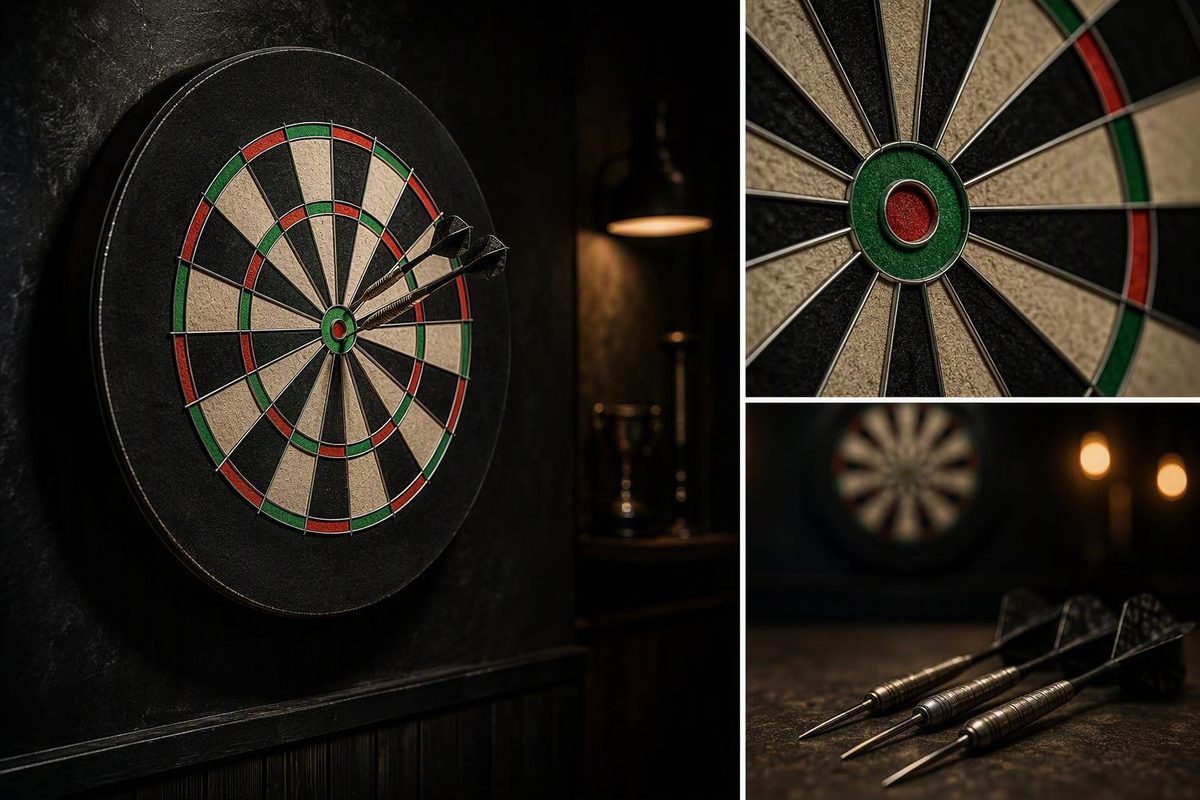
Under DRA rules, a standard steel-tip bristle dartboard is 451 mm across—approximately 17¾ inches. Its scoring area is smaller: 340 mm across, measured between the outside edges of the double ring. For installation, the key measurements are 1.73 m from the floor to the bull centre and 2.37 m horizontally from the board face to the throwing line. These are separate measurements: board diameter tells you its size, not how much playing space you need. (DRA rules, sections 6.5–6.7; sports dimensions guide)
Steel-tip board dimensions
The following dimensions apply to the standard numbered steel-tip board, not an electronic soft-tip board or a specialist practice target.
| Part of the board | Metric dimension | What is measured |
|---|---|---|
| Overall board diameter | 451 mm | Full board, not just the scoring area |
| Scoring-area diameter | 340 mm | Outside edge of the double wire to the opposite outside edge |
| Double-ring width | 8 mm | Inside measurement of the narrow outer scoring band |
| Treble-ring width | 8 mm | Inside measurement of the narrow inner scoring band |
| Inner bull diameter | 12.7 mm | Inside diameter of the central bull |
| Outer bull diameter | 31.8 mm | Inside diameter of the outer bull boundary, including the inner bull within it |
| Bull centre to outer edge of double wire | 170 mm | Radius of the scoring area |
The ring and bull measurements are specified in Darts Western Australia’s playing rules, section 13.4; the government sports dimensions guide also explicitly gives the 340 mm scoring-area diameter.
Do not confuse diameter with ring width. The outer bull’s 31.8 mm measurement runs across the whole circle enclosed by its boundary; it is not the width of the green band around the inner bull.
Why some boards are listed as 450 mm
The DRA’s 2026 rulebook specifies a 451 mm bristle board. However, manufacturers may list a product at 450 mm: for example, Winmau gives the Blade 6’s dimensions as 450 mm diameter × 38 mm thickness and says it is made to WDF specifications. Use the actual model’s measurements when checking fit, rather than treating every product listing as an exact 451 mm. (DRA rule 6.5.2; Winmau Blade 6 specifications)
The 38 mm thickness is a specification for that model, not a universal thickness to assume for every board. For construction and buying checks, see our bristle dartboard guide.
Mounting height and floor space
For a standard DRA setup:
- Position the bull centre 1.73 m above the floor, measured at the same floor level as the oche.
- Keep the black 20 segment at the top.
- Measure 2.37 m horizontally from the board’s front face to the back of the raised oche—the player-side edge against which your toe rests.
These requirements appear in DRA rules 6.5.9–6.5.10 and 6.7.1.
Worked setup example: if the mounted board face projects 50 mm from the wall, the throwing line must be 2,420 mm from that wall: 2,370 + 50. Measuring only 2,370 mm from the wall would leave you 50 mm too close.
When planning the room, allow additional space behind the line to stand and move, and use the external dimensions of any surround, cabinet or light—not the bare board diameter. Our official dartboard distance guide covers the setup measurements in more detail.
Electronic soft-tip boards are a separate size check
Do not apply the 451 mm steel-tip figure automatically to soft-tip equipment. Check the specific model’s full external dimensions and mounting instructions, rather than relying on an advertised playing-area size. For example, DARTSLIVE provides a model-specific user manual for its Home board. Confirm your competition’s throwing-distance rules before marking out the space.