
Dart Board Dimensions: Full Board Size vs Scoring Area
A standard steel-tip dartboard is nominally 451 mm across, with a 340 mm scoring area. Check bull sizes, ring measurements, thickness and setup.
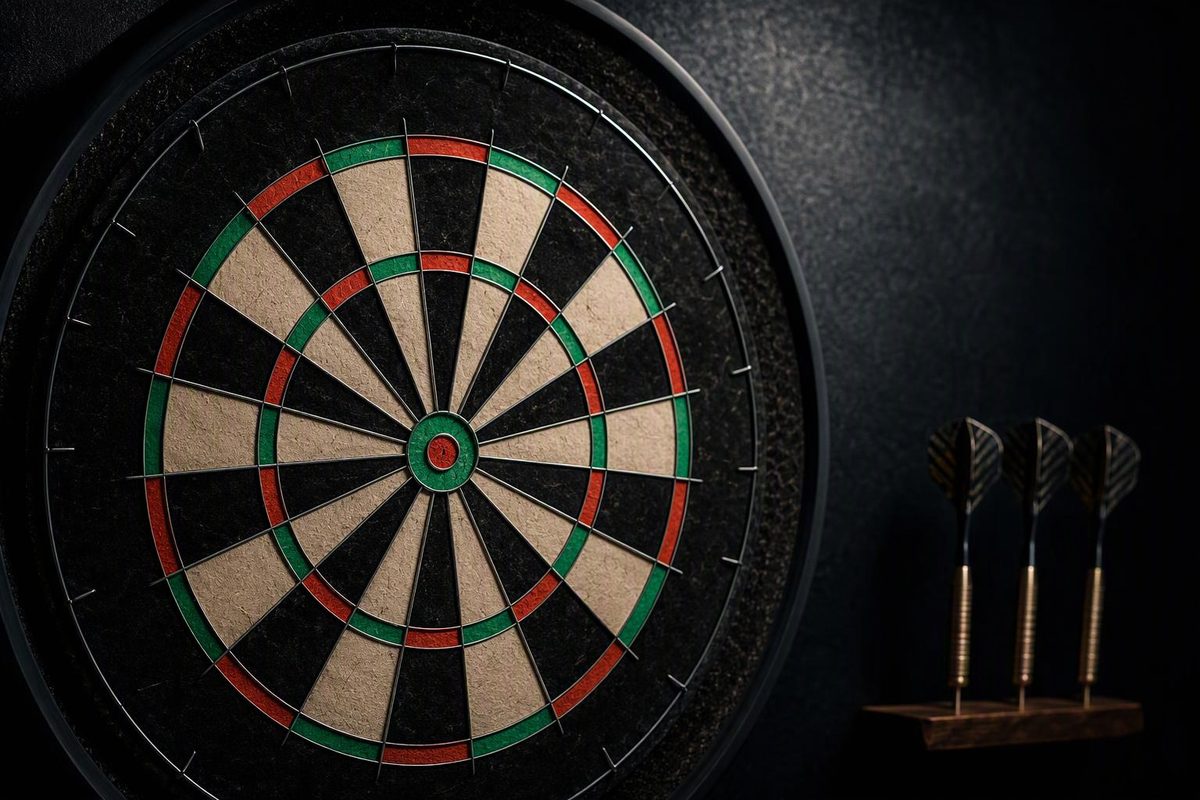
A standard steel-tip dartboard is nominally 451 mm in diameter—45.1 cm, or approximately 17¾ inches. The scoring area is smaller: 340 mm across, measured between the outside edges of the double wire. Those are different measurements, so do not mistake a board’s full diameter for the size of the target. Both appear in the World Darts Federation’s board specifications.
These dimensions apply to the standard bristle board used for steel-tip darts, not automatically to an electronic soft-tip board.
Standard dartboard measurements
The WDF specification distinguishes diameters, distances from the bull centre, and ring widths. A diameter runs all the way across a circle; a distance from the centre is a radius.
| Part being measured | Nominal dimension | How to measure it |
|---|---|---|
| Full dartboard | 451 mm | Across the board body |
| Scoring area | 340 mm | Outside edge of double wire to opposite outside edge |
| Inner bull | 12.7 mm | Inside diameter of the small central circle |
| Outer bull boundary | 31.8 mm | Inside diameter of the ring enclosing both bull areas |
| Double ring position | 170 mm | Bull centre to outside edge of double wire |
| Treble ring position | 107.4 mm | Bull centre to outside edge of treble wire |
| Double and treble widths: conventional wire boards | 8 mm | Inside edge to inside edge |
| Double and treble widths: strip-material boards | 10 mm | Apex to apex of the dividing strips |
Source: WDF Playing and Tournament Rules, section 4.01 (2018 revision 20). These are nominal dimensions with specified tolerances; the overall diameter tolerance is ±3 mm.
The 31.8 mm outer-bull measurement is not the width of the green band. It is the diameter across the whole area enclosed by its outer boundary, including the inner bull.
Similarly, the two ring-width figures use different measurement methods. An 8 mm inside-to-inside measurement and a 10 mm apex-to-apex measurement should not be treated as directly comparable clear target widths.
Why a full-size board may be listed as 450 mm
The 2026 DRA rulebook, section 6.5.2, specifies a 451 mm bristle board. Product listings can use a slightly different figure: for example, Winmau lists the Blade 6 as 450 mm in diameter and 38 mm thick, and states that it is made to WDF specifications. That listed diameter is within the WDF’s ±3 mm tolerance.
Thickness is a separate product specification. The Blade 6’s 38 mm depth—about 1½ inches—is a model-specific figure, not a universal thickness requirement in the cited WDF dimensions table.
For a replacement board or tight cabinet, check the exact product dimensions and mounting arrangement rather than relying only on an “18-inch” label. A surround, cabinet or lighting ring also needs its own clearance; the board diameter does not tell you the total wall space required. Our bristle dartboard buying checklist covers the other setup details to check.
Mounting height and throwing distance
Board size and installation measurements are separate. For a standard DRA steel-tip setup:
- Bull centre height: 1.73 m above the floor, with the floor at the same level as the oche.
- Horizontal throwing distance: 2.37 m from the board face to the back of the raised oche—the player’s side.
- Orientation: the black 20 segment sits at the top.
These are specified in DRA rules 6.5.9–6.5.10 and 6.7.1. Measure from the board face, not the wall: the board and mounting hardware project into the room. See our official dartboard distance guide for the full measuring procedure.
If you are buying an electronic soft-tip board, check its manual for the playing-area size, overall housing dimensions and installation requirements. Do not assume its advertised diameter refers to the same part of the board as the steel-tip measurements above.