
What Littler’s Quoted 12-Darter Chance Actually Tells You
Littler’s quoted 4:1 chance means 20% if read as odds against, not 25%. Compare the wording, 200-leg sample and exact-12 versus four-visit definitions.
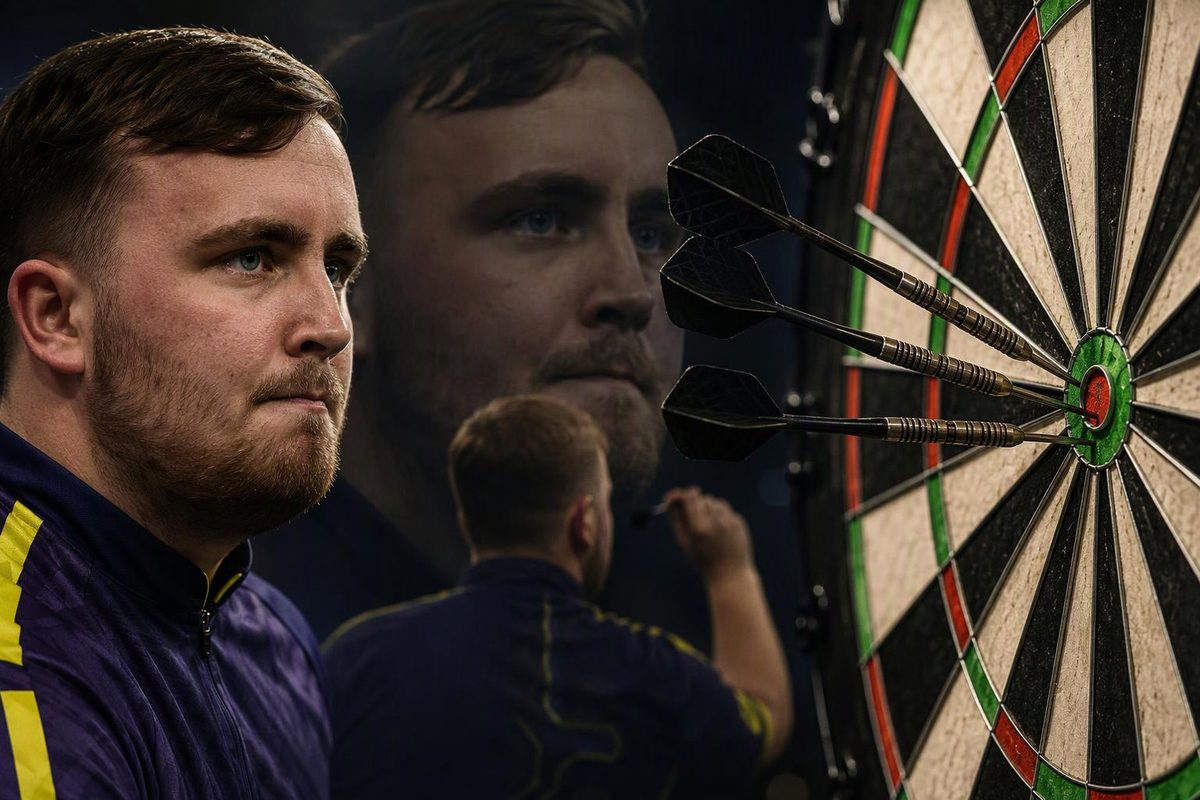
Luke Littler’s quoted 12-darter probability is 20% if the PDC’s “4:1 chance” means conventional odds against; “one in four” means 25%. The PDC used the former wording in its 4 August 2026 Form Guide, while Darts News described it as approximately one in four. Because the PDC did not explicitly say “odds against”, those descriptions do not establish one unambiguous percentage. The claim concerned recent form, not a verified career rate. (PDC report, Darts News coverage)
The defensible answer therefore has two parts: the odds conversion is clear, but the underlying statistic needs clarification. Neither published description supplies a counted numerator and denominator that resolves whether the intended rate was 20% or about 25%.
Choose the wording you want to interpret; the result separates its mathematical meaning from the unresolved statistic.
Interpret the Quoted Chance
This checks the meaning of the wording, not Littler’s recorded finish count.
20% follows if “4:1” means odds against. Secondary coverage says about one in four (~25%). The published wording does not settle the intended rate.
| Interpretation | Calculation | Result |
|---|---|---|
| 4:1 against | 1 ÷ (4 + 1) | 20% |
| One in four | 1 ÷ 4 | 25% |
| Verified finish frequency | Count not supplied | — |
Source: PDC, 4 August 2026; Darts News’s approximation as cited above. Recent-form context: last 200 legs; exact-12 versus 12-or-fewer is not specified in the quotation.
Why 4:1 Against Means 20%, Not 25%
Odds against compare unsuccessful outcomes with successful outcomes. At 4:1 against, there are four failures for each success. That makes five outcomes altogether, with the successful outcome accounting for one of them.
Probability = 1 ÷ (4 + 1) = 20%.
“One in four” uses a different denominator. It means one success among four total outcomes, not one success alongside four failures.
Probability = 1 ÷ 4 = 25%.
The corresponding odds against are therefore 3:1: three failures for every success. The difference is arithmetic, not a judgement about Littler’s ability.
| Wording | What Is Being Compared | Probability |
|---|---|---|
| 4:1 odds against | Four failures to one success | 20% |
| One in four | One success in four outcomes | 25% |
| “4:1 chance” | Convention not specified | Unresolved |
The PDC’s wording was “4:1 chance of completing a 12-darter in any given leg”. Reading that as standard odds against gives a precise conversion, but it is still an interpretation of the wording. It does not prove that the underlying leg data contained exactly that percentage of 12-darters.
Darts News’s “about a one-in-four chance” is also a description rather than a published count. “About” signals approximation; it does not make 4:1 odds against mathematically equivalent to one in four. There could be rounding or loose language behind either description, but the prose does not establish which explanation applies.
For a reference answer, retain the distinction rather than choosing the more convenient number. Write “20% if interpreted as 4:1 odds against”, or attribute “approximately one in four” to the secondary report. Writing simply “Littler has a 25% chance” removes a qualification that the evidence still needs.
A 12-Darter Finishes With the Twelfth Dart
A 12-darter means completing a 501 leg with your twelfth dart. Opponents’ darts are not included in that count. In standard double-out 501, the score must reach exactly zero and the finishing dart must land on a double. (PDC Europe rules)
Here is an illustrative route, not a recorded Littler leg. T means treble, S single and D double.
| Visit | Three Darts | Score | Remaining |
|---|---|---|---|
| 1 | T20, T20, T20 | 180 | 321 |
| 2 | T20, T20, S20 | 140 | 181 |
| 3 | T20, S20, S20 | 100 | 81 |
| 4 | T19, S8, D8 | 81 | 0 |
The first three visits score 420, leaving 81. The fourth visit scores 57 with T19, then eight with S8, leaving 16 for D8. The double is the twelfth dart, so the leg is an exact 12-darter.
That completed leg’s three-dart average is 501 ÷ 12 × 3 = 125.25. This is the average for the illustrated leg alone. It is not Littler’s match average, his rolling average or evidence that every leg played at that scoring level ends in 12 darts.
The example also shows why the finishing requirement matters. Reaching a useful checkout after three visits is only part of the route: the remaining score still has to be taken out legally within the fourth visit. The published probability describes a completed outcome, not merely the chance of leaving a finish.
Our 501 rules guide explains the scoring and checkout requirements in more detail.
Exactly 12 Darts Is Different From Four Visits or Fewer
An exact-12 statistic counts legs completed with the twelfth dart. A 12-or-fewer statistic includes faster finishes as well: nine-, ten- and eleven-dart legs also qualify. Those are different events, even though both descriptions concern very quick legs.
A four-visit measure can therefore be broader than an exact-12 measure. For a completed leg, finishing within four visits does not require using all three darts of the fourth visit. Finishing on its first or second dart is faster than an exact 12-darter, but still falls within the four-visit limit.
The quoted sentence does not specify whether “12-darter” is being used strictly or as shorthand for finishing within four visits. That ambiguity remains even after choosing an interpretation of “4:1”. Resolving the odds notation would tell us how to express the probability; it would not tell us which legs were counted as successes.
| Measure | Qualifying Finish | Main Distinction |
|---|---|---|
| Exactly 12 darts | The twelfth dart | Excludes faster legs |
| 12 darts or fewer | No later than dart 12 | Includes faster legs |
| Within four visits | No later than visit four | Need not use dart 12 |
An exact-12 rate cannot exceed the rate for 12 or fewer when both use the same denominator: every exact-12 finish belongs in the broader group, but the broader group can contain additional finishes. No numerical gap between those measures can be calculated from the quoted wording alone.
This matters when comparing players. One player’s exact-12 frequency and another’s four-visit completion rate are not interchangeable. A table may display both as percentages, but matching the units on the page is not enough; the definition of a successful leg must match too.
The Claim Came From a Last-200-Legs Form Sample
Christopher Kempf’s August analysis assessed players using their last 200 legs played, in an update published following the 2026 World Matchplay. It was a recent-form comparison among PDC Tour Card holders, not Littler’s complete career, a pub-darts benchmark or a forecast tailored to his next opponent. (PDC August Form Guide)
The 200-leg window gives the analysis a defined recent-form scope. It does not, by itself, provide the raw count behind the particular 12-darter claim. The quoted prose does not supply a numerator paired with a clearly defined denominator for that event.
A reproducible frequency needs both: how many qualifying finishes occurred, and how many eligible legs were assessed. It also needs the rule for “qualifying”, especially here, where exactly 12 and 12-or-fewer would produce different counts.
The difference between a playing sample and a forecast is equally significant. A percentage measured over recent legs summarises those legs. Applying it to “any given leg” treats that recent performance as a guide to a future opportunity. The published claim does not provide a separate adjustment for opponent or match situation.
That does not make the form guide useless. It makes it a recent-form reference rather than a personalised prediction. A reader comparing elite players can use the stated sample context; a reader predicting Littler’s next leg should not mistake the headline wording for an opponent-specific model.
Nor should the figure be carried into a career profile without its date and window. A rolling last-200-legs sample and a career sample answer different questions, even if both happen to produce similar percentages.
A Three-Dart Average Does Not Supply This Probability
The illustrated 12-darter has a three-dart average of 125.25 because all 501 points are completed in 12 darts. It is tempting to reverse that relationship and use a player’s overall average to infer how often he throws a 12-darter. The aggregate average does not contain enough information to do that.
The completed-leg calculation describes one known route from 501 to zero. An overall average combines scoring across the measured sample. It does not show how many individual legs finished on dart 12, how many finished earlier, or how many took longer.
Players can distribute their scoring and finishing differently while producing similar aggregate averages. To recover an exact-12 frequency, you need the leg-by-leg finish counts, not just a single average. The 125.25 figure is a worked illustration of one leg’s arithmetic, not a threshold that converts a player average into a probability.
The same distinction applies to the example’s scoring sequence. Two strong opening visits help create the route, but the route still requires the remaining visits and the finishing double. Counting a scoring feature alone would measure a different event from completing the entire leg in 12 darts.
OChE Is a Leg-Winning Estimate, Not a 12-Darter Rate
Ordinal Checkout Efficiency (OChE) is another separate measure. The PDC defines it as an estimated percentage of legs won against ProTour opposition, calculated from weighted four-, five-, six- and seven-visit checkout rates. (PDC’s OChE explanation)
The percentage format can make OChE look comparable to a 12-darter probability, but its result answers a different question. It estimates leg-winning performance against a specified level of opposition. An exact-12 rate counts one particular finishing outcome.
OChE also uses several checkout-speed categories, rather than isolating the twelfth dart. Its value cannot be substituted for the missing 12-darter count, and the August claim should not be labelled as OChE simply because both appear in form-guide coverage.
Keep the measures separate when reading a player summary: average describes scoring output, the quoted 12-darter claim concerns finishing speed, and OChE estimates leg-winning performance. A change in one does not supply a numerical replacement for another.
Later Form Guides Do Not Establish a New 12-Darter Rate
Treat the quotation as an August 2026 form claim, not a fixed property of Littler’s game. On 9 September, the PDC reported that his average and OChE had fallen from their earlier highs, although he still led both measures. By the 27 September Form Guide, Gerwyn Price led average and OChE narrowly. Neither update supplies a replacement 12-darter probability in its prose. (9 September update, 27 September update)
Those later reports establish movement in the measures they discuss. They do not establish how far an exact-12 or four-visit completion rate moved. There is no defensible way to scale the August probability down merely because average or OChE declined.
For a clean reference entry, the usable wording is: the PDC quoted a “4:1 chance” in its August last-200-legs analysis; that converts to 20% if read as odds against, while secondary coverage described approximately 25%. The counted frequency and exact finishing definition remain unresolved in the cited prose.
Any stronger comparison needs the sample date, the denominator and a definition specifying exactly 12 darts or 12-or-fewer. Until those are supplied, “one in four” is a headline-level description of Littler’s recent form, not a reproducible career statistic or a verified current probability.