
Your First 180 Has No Reliable Deadline
Accounts range from a few league sessions or several weeks to roughly two years, but they cannot establish a normal range, prediction or deadline.
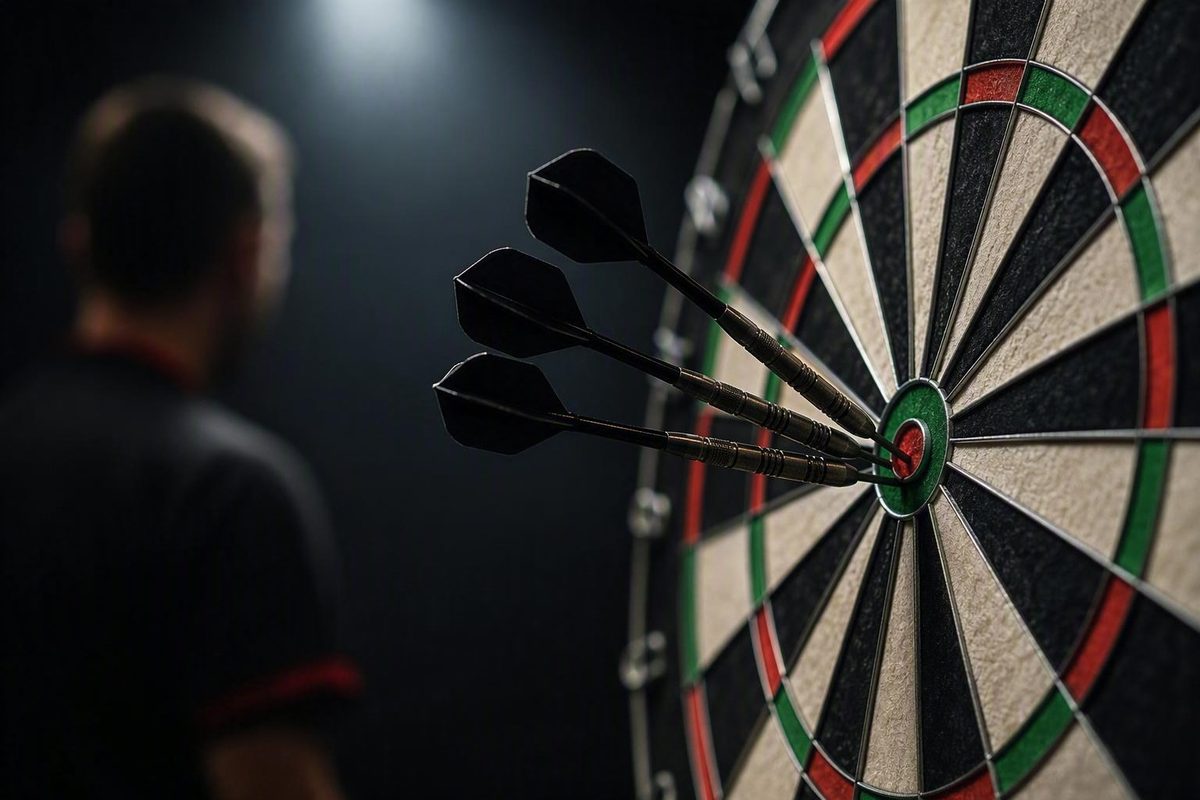
Individual accounts range from a few league sessions or several weeks to roughly two years, but that is an anecdotal span—not a normal range, prediction or deadline. Six months without a 180 does not, by itself, mean you are progressing unusually slowly.
The short answer: weeks for some players, years for others
Some players in a small set of self-reported accounts say their first maximum arrived within weeks; others describe waiting months or about two years. One account places it after only a couple of league sessions, but does not disclose how much earlier practice the player had done. These reports illustrate variation rather than establish what a beginner should expect, as the individual answers collected on Quora are self-selected and unverified.
The central problem is that “six months of darts” can describe very different levels of activity. It might mean ten minutes occasionally, an hour every day or weekly league matches supported by additional practice. Calendar time does not reveal practice hours, session frequency, total darts thrown, previous experience or whether the milestone is being attempted in practice or competition.
A Reddit question from a player with six months of experience shows that the concern is real. It does not, however, supply a measured practice-hour benchmark or demonstrate that a maximum should have happened by six months.
The honest answer is therefore simple: your first 180 might arrive quickly or take much longer, and the available evidence cannot provide a reliable typical time.
What officially counts as a 180?
A 180 consists of three treble 20s in one three-dart visit:
- A treble 20 scores 60.
- Three darts scoring 60 each produce 60 × 3.
- The visit total is 180.
That is the maximum score possible in a standard three-dart visit. A 140 made with two treble 20s and a single 20 is a strong near-miss, but it is not a 180. The score also cannot be accumulated across separate visits: all three darts must land in treble 20 during the same visit. The PDC Europe rules confirm that the treble ring scores three times the segment value, making treble 20 worth 60.
Reported first-180 timelines compared
The following accounts use incompatible measurements: some give calendar dates, some estimate months or seasons, and one counts darts thrown. Grouping them by source keeps each claim traceable without suggesting that the figures form a statistical sample.
| Reported milestone | Practice context | Important qualification | Source type |
|---|---|---|---|
| Around three months of regular daily practice; another first 180 after more than 23,000 tracked throws plus an estimated 5,000–6,000 untracked darts, or about 28,000–29,000 in total | Daily practice in one account; total throwing volume after returning to darts in the other | Session length and practice structure were not standardized. The dart total describes one player’s experience, not a typical requirement | DartsNutz forum self-reports |
| Daily play from July 5 to August 25, about seven weeks; an estimate of within six months; a couple of league sessions; a first maximum in a second league season; approximately two years in a childhood soft-tip account; practice 180s but no match 180 after two years | Daily play, league competition, soft-tip play, and practice-versus-match experiences | Earlier practice was unstated in the league-session account. Several timings were uncertain, a season is not a standard unit, and soft-tip should not be treated as directly comparable with steel-tip | Quora self-reports |
| By the fifth month after returning to darts, one player reported that the first 180 had occurred in mid-February following an approximately 20-year gap | Returning player rather than a complete beginner | The exact restart date was not supplied, so the interval to the first maximum cannot be calculated precisely | DartsNutz forum self-report |
Averaging these figures would create false precision. The accounts come from small, self-selected groups and were not independently verified. They also measure different things: elapsed weeks, estimated months, league seasons and total darts.
For the same reason, none of the individual results should become a personal deadline. Seven weeks does not show that daily practice produces a 180 within seven weeks, just as approximately 28,000–29,000 darts does not show how many throws another player will need.
Why two players can have completely different timelines
Four measurements commonly become blurred together:
- Calendar time: the number of weeks or months since starting.
- Practice time: the number of hours spent actively throwing.
- Sessions: how often someone practises or competes.
- Throwing volume: the number of darts or three-dart visits completed.
These measurements are not interchangeable. Two players may both say they have played for six months while having completed radically different numbers of visits. Even equal throwing volumes can be distributed differently between short daily sessions and occasional longer sessions.
Comparisons are further limited by variables that the reports either document inconsistently or omit:
- Frequency of play: “regularly” could mean daily or weekly.
- Previous experience: a returning player is not starting from the same position as a complete beginner.
- Throw consistency: the accounts do not use a common measure of repeatability or grouping.
- Board type: soft-tip and steel-tip reports should not be pooled without qualification.
- Playing context: practice and competitive visits can produce different milestones.
- Record keeping: a contemporary throwing log provides different evidence from an estimate recalled years later.
The account from a player returning after an approximately 20-year gap demonstrates why “months since starting” can be misleading. That player was relearning rather than encountering darts for the first time.
Practice and match maximums should also be recorded separately. One self-described player reported practice 180s after two years without having hit one in a match. That does not establish why the timelines differed, but it does show that a first practice 180 and a first competitive 180 are not necessarily the same milestone.
Taken together, these reports cannot establish an average, median, success probability or guaranteed range. They show that experiences differ; they cannot tell you what percentage of beginners will hit a maximum within any particular period.
Track progress by opportunities, not just months
A session log gives you a more informative record than elapsed calendar time alone.
| Field | What to record |
|---|---|
| Date | Session date |
| Practice minutes | Active throwing time |
| Total darts thrown | Exact count or a consistent estimate |
| Treble-20 hits | Darts landing in treble 20 |
| Two-treble near-misses | Visits beginning with two treble 20s but not ending in 180 |
| Grouping notes | Tight around the 20, drifting low or spreading sideways |
| Three-dart average | Average for the recorded session or completed legs |
| 180 counts | Separate totals for practice and competitive matches |
This log will not predict when your first 180 will arrive. Its value is that it distinguishes active throwing from time merely passing and lets you compare your current sessions with your own earlier results.
The report of more than 23,000 tracked throws plus an estimated 5,000–6,000 untracked darts illustrates the difference. A total of approximately 28,000–29,000 darts describes exposure to the target more clearly than “several months,” even though it remains one person’s experience and cannot be converted into a general requirement.
While waiting for the maximum, look for progress below the headline score:
- Are the darts grouping more tightly around the 20?
- Are treble-20 hits becoming more frequent?
- Are two-treble visits appearing more often?
- Is the three-dart average becoming steadier across complete legs?
- Are weaker visits doing less damage to the overall average?
Those changes can indicate greater scoring consistency even when a 180 has not arrived. Conversely, one isolated maximum does not necessarily demonstrate strong overall scoring or match performance. Three darts can align during an otherwise inconsistent session.
For a broader way to measure scoring development, the Dartboard Stats guide What Is a Good Three-Dart Average? explains how to record and interpret a three-dart average. Treat it as a separate progress measure, not as a way to predict a first-180 date.
When the third dart suddenly feels different
Several forum contributors described excitement, panic or tension after landing the first two darts in treble 20. Once the maximum becomes visibly available, the third throw may no longer feel like an ordinary dart.
Recurring community advice is to preserve the same setup, tempo, release and follow-through used for the first two darts. In practical terms, that means avoiding a dramatic pause, an unusually long aim or a deliberate attempt to steer the final dart. This is anecdotal advice, not a validated performance intervention.
One contributor suggested a “fake 180” exercise: rehearse the final throw while imagining that two darts are already in treble 20. The aim is to make the pressure cue feel more familiar while keeping the throwing process ordinary.
Other techniques mentioned by players include:
- Counting a consistent rhythm through setup, backswing and release.
- Using an existing dart or its flight as a visual reference.
- Holding a fourth dart while throwing only three, so the third feels less final.
- Completing the follow-through before reacting to the result.
The supplied accounts do not prove that any of these methods improve performance. The narrower principle is more useful: do not deliberately force or redesign the third throw solely because a 180 is available.
There is no defensible deadline for a first 180. Use reported timelines only to understand how widely individual experiences can differ, and judge your own development through throwing volume, grouping, treble hits, near-misses and scoring consistency—not one maximum visit.