
Raymond Smith’s Canberra semi-final 180 rate: 0.625 per leg
Five 180s in eight legs gave Raymond Smith a 0.625-per-leg rate on 26 September 2026. See the calculation and his record-setting 108.88 average.
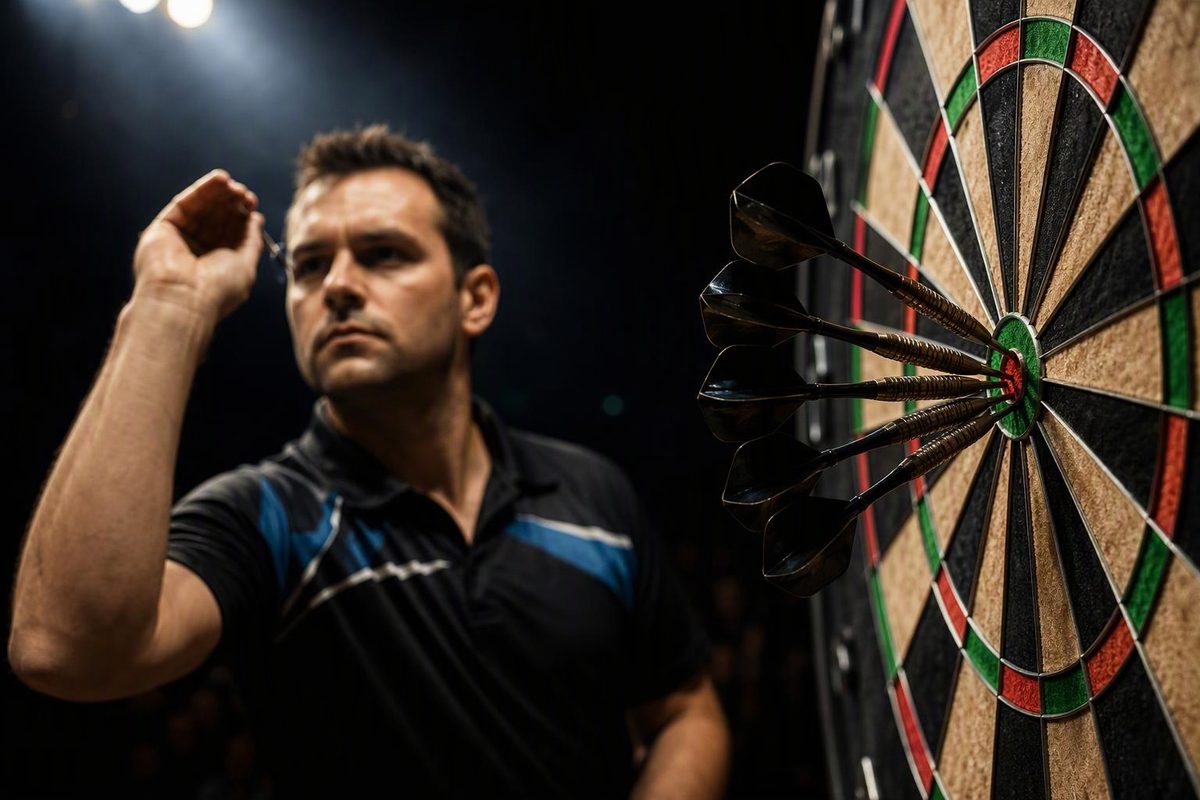
Raymond Smith hit five 180s in eight legs against Mal Cuming on 26 September 2026: a calculated rate of 0.625 maximums per leg. That was his semi-final at the opening night of the Dabble Darts ANZ Premier League in Canberra, which he won 5–3 with a 108.88 three-dart average. The PDC reported the average as an ANZ Premier League record—not the 180 rate. PDC event report
How the 180 rate is calculated
A 180 is a three-dart visit consisting of three treble 20s: 60 + 60 + 60 = 180. For example, an opening 180 in a 501 leg leaves 321. It counts as one maximum, not three.
For Smith’s semi-final, divide his maximums by all legs played, including the three Cuming won:
5 ÷ (5 + 3) = 0.625 180s per leg
That is equivalent to one 180 per 1.6 legs, or 6.25 per ten legs if the same rate were maintained. The ten-leg figure is a rescaling of the observed performance, not a prediction.
Dividing by Smith’s five winning legs would produce 1.0, but that would not be his match-wide rate: it would exclude three legs in which he also threw darts.
Nor does 0.625 mean he hit a 180 in 62.5% of legs. Multiple maximums can occur in one leg, so the distribution matters. A percentage of visits scoring 180 would require a different denominator—the total number of visits—which the five-maximum count and match score alone do not supply.
Which match does the number describe?
The five 180s and 108.88 average belong specifically to the Cuming semi-final. Smith played three matches on Night One:
| Round | Opponent | Smith’s result | Smith’s three-dart average |
|---|---|---|---|
| Quarter-final | Brody Klinge | Won 5–3 | 90.68 |
| Semi-final | Mal Cuming | Won 5–3 | 108.88 |
| Final | Ben Robb | Won 5–1 | 94.67 |
Source: DartConnect’s Night One match results, also reproduced in the DartsNews report.
The semi-final rate should therefore not be labelled Smith’s whole-night or season-long 180 rate. Those measures require his maximum count across the relevant matches and their combined leg count. Likewise, 108.88 was not his nightly average; combining match averages accurately requires weighting by darts thrown rather than taking a simple mean.
What the maximums reveal—and what they miss
The five maximums capture Smith’s peak scoring, but his finishing also mattered. The PDC reported that four of his five winning legs against Cuming took 14 darts or fewer, including an 11-dart finish in the eighth and final leg. Cuming averaged 95.04, according to DartConnect. PDC report · Match results
For benchmarking, this is one eight-leg sample from a professional competition, not a pub- or local-league expectation. Record your own maximums and total legs over a consistent sample, then read that rate alongside your overall average and finishing. A 180 count alone cannot tell you how efficiently a player turns scoring into won legs.