
Clayton’s Double 16 Figure Measures Recent Form, Not His Season
The PDC reported Clayton above 50% on D16 and at 46% across doubles. See the sample limits, World Grand Prix context, and how to measure your own rate.
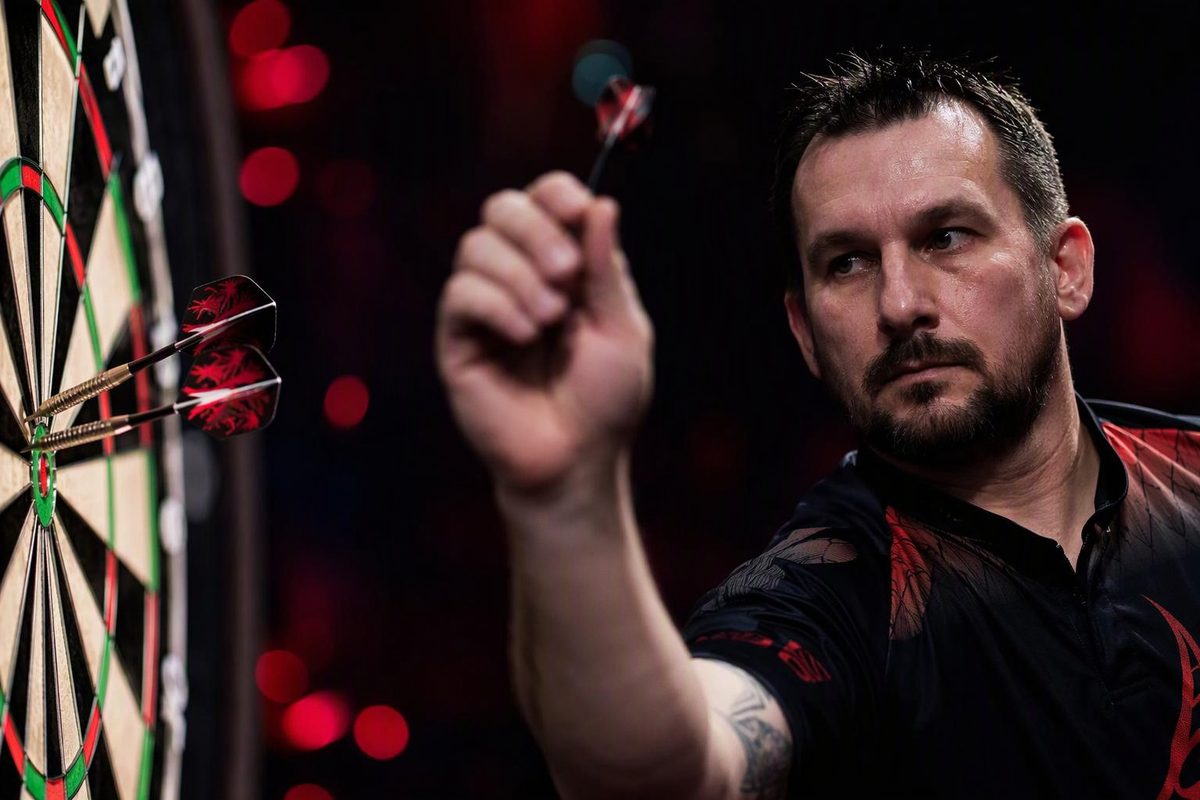
Jonny Clayton’s double 16 accuracy was more than 50% in the PDC Form Guide published on 27 September 2026. His overall doubles accuracy was 46%, and Christopher Kempf identified him as the PDC’s leading doubles hitter for more than a month. Those are recent-form figures from an assessment covering players’ last 200 legs, not Clayton’s full 2026 season. The report does not supply an exact D16 percentage or his underlying D16 hit-and-attempt count.
Enter your D16 hits and attempts to calculate your rate; Clayton’s reported figure stays alongside it.
D16 Accuracy Calculator
Your Sample
60% (6/10)
Your rate is above 50%, but Clayton’s exact D16 rate is unknown. This does not establish that you outperformed him.
Use whole-dart counts, including every miss. The starting 6/10 is an illustrative record, not Clayton’s data.
| Clayton Measure | Reported Value |
|---|---|
| D16 accuracy | More than 50% |
| Overall doubles | 46% |
| Assessment window | Last 200 legs |
| D16 attempt count | — Not supplied |
Comparison Limits
The report describes recent form, not the full 2026 season or a separate double-in success rate. Practice and match records should be labelled separately. An exact personal percentage cannot be ranked against Clayton’s unpublished exact rate.
Source: PDC Form Guide, 27 September 2026. Personal accuracy = hits ÷ attempts × 100.
The Published D16 Figure Is A Lower Bound
The wording “more than 50%” supports a specific conclusion: Clayton hit more than half of his attempts at D16 in the assessed sample. It does not support a more precise percentage. Without the underlying counts, there is no way to reconstruct that percentage from the report.
The published figures answer different questions:
| Measure | Reported Result | Scope |
|---|---|---|
| D16 accuracy | More than 50% | Attempts at D16 |
| Overall doubles accuracy | 46% | Finishing attempts across doubles |
| Form window | Last 200 legs | Recent form, not the season |
| D16 hits and attempts | Not supplied | Exact rate unavailable |
The 200-leg window is the frame for the assessment, not the denominator of Clayton’s D16 percentage. A leg can produce different numbers of darts at doubles, and a player does not necessarily attempt D16 in every leg. Dividing a D16 hit count by 200 would therefore measure something other than accuracy at that target.
This also limits comparisons. If another player reports a precise D16 percentage above 50%, Clayton’s published lower bound alone cannot establish which player was more accurate. The same applies when you compare your own practice record with his figure. Your exact percentage and his threshold are not equivalent pieces of information.
For the query “Jonny Clayton double 16 accuracy 2026,” the defensible answer is therefore over 50% in the late-September recent-form assessment. Presenting that as an exact season percentage would change both the precision and the scope of the source.
D16 Accuracy Counts Darts, Not Completed Checkouts
Double 16, usually written D16, scores 32 points. Target-specific accuracy measures successful hits as a proportion of darts attempted at that target, following the method used in Kempf’s analysis of individual doubles.
D16 accuracy = D16 hits ÷ D16 attempts × 100.
Consider the illustrative finish from 32 remaining in the draft: the first dart misses outside D16, leaving 32, and the second dart hits D16 to win the leg. The player has completed the checkout, but has hit one of two D16 attempts: 50% accuracy.
That distinction is the core of the statistic. The successful checkout does not erase the first miss. A record that counts only the final successful dart would overstate the player’s accuracy because it would omit an attempt from the denominator.
Nor is the denominator the number of visits in which the player eventually finished. A visit can contain both misses and a hit. Counting it simply as a successful visit answers a different question from counting the darts directed at the target. For the scoring and finishing rules behind that distinction, see our 501 rules and checkouts guide.
Clayton’s figure consequently does not mean he finished more than half of all his legs on D16. It describes how often a dart aimed at that double succeeded within the assessed sample. The report does not provide the separate information needed to say what proportion of his legs ended there.
Keeping the denominator visible is especially useful when reading a headline. “Over 50% on D16” sounds straightforward, but it becomes meaningful only when attached to attempts at that target, a defined sample and the source’s actual level of precision.
The 46% Overall Rate Does Not Describe Every Double
Clayton’s 46% overall doubles accuracy covers his finishing attempts across targets. His over-50% D16 rate isolates one target. The latter was higher than his reported overall rate, but the two figures are not contradictory: they describe different sets of attempts.
An overall rate pools successful hits and attempts across doubles. It is not a statement that the player hits every individual double at that same rate. Equally, a strong result on D16 does not establish an equally strong result on another double. The September report supports the D16 claim and the overall claim; it does not supply an individual accuracy figure for every other target.
The overall result also cannot be treated as a simple average of target percentages without knowing how many attempts were made at each target. Targets used more often contribute more attempts to the pooled record. The published figures do not give the target-by-target counts needed to reconstruct that calculation.
This is why the distinction matters for a player deciding what to practise. An overall finishing rate can show how often the player converts doubles collectively, while a D16 record shows performance at that particular target. One cannot substitute for the other when identifying where misses occur.
Kempf’s description of Clayton as the PDC’s leading doubles hitter for more than a month concerns his doubles performance. It should not be enlarged into a claim that he led every individual-double ranking. Nor does it establish that he was the best scorer, the best player over the entire season or the most likely tournament winner. Those would require different evidence.
The Earlier Scoring Average Belongs To Another Window
In the 9 September 2026 Form Guide, Clayton led doubles accuracy despite a 94.62 three-dart average, which ranked 20th in that assessment. Those figures provide useful context for the separation between scoring and finishing, but they belong to the earlier rolling window.
They should not be attached to the later D16 snapshot as though all the numbers came from one unchanged sample. Rolling form reports move forward as the assessed legs change. The earlier average describes the earlier assessment; the late-September D16 statement describes the later one.
| Assessment | Clayton’s Reported Measure | Result |
|---|---|---|
| 9 September 2026 | Three-dart average | 94.62 |
| 9 September 2026 | Average ranking | 20th |
| 27 September 2026 | Overall doubles accuracy | 46% |
| 27 September 2026 | D16 accuracy | More than 50% |
The earlier report shows that leading doubles accuracy can coexist with a lower position in the scoring-average ranking. It does not establish why Clayton occupied either position. There are no target-attempt counts in the supplied material that would allow a detailed breakdown of how his finishing contributed to his average.
For interpreting player form, keep the measures side by side rather than merging them into a single verdict. The average and doubles accuracy describe different aspects of performance, and their dates matter. Our explanation of first-nine average versus checkout percentage develops that scoring-versus-finishing distinction.
D16 Form Had Specific World Grand Prix Relevance
The World Grand Prix requires players to begin and finish every leg on a double or the bullseye, according to the PDC tournament guide. Doubles therefore matter at the start of a leg as well as at its finish. That format explains why Kempf highlighted Clayton’s D16 form in the build-up.
There is still a measurement boundary. The reported D16 finishing figure is not a separately measured double-in success rate. Using the same target to start and finish does not make those two records interchangeable. To state Clayton’s double-in accuracy, the evidence would need to identify successful opening darts and opening attempts separately.
The report does not provide those counts. It also does not turn the D16 figure into a probability that Clayton would win a match or the tournament. That would require evidence beyond the supplied finishing statistic.
The useful reading is narrower: Clayton arrived in the report with strong recent conversion on a double relevant to a double-start event. The format made that skill especially pertinent, while the data still described the finishing sample actually reported.
For the same reason, the figure does not prove that D16 was the best starting target for every player. Clayton’s target-specific form is evidence about Clayton in that sample, not a universal prescription. A player choosing a starting double would need their own relevant record rather than treating a professional’s finishing percentage as a personal double-in forecast.
Your Own D16 Record Needs A Stated Sample
For pub and league players, Clayton’s figure is an elite professional reference point, not an established amateur benchmark. The supplied evidence contains no amateur D16 distribution, no recommended league-player threshold and no practice-to-match adjustment. It cannot show where a particular amateur percentage sits among comparable players.
You can still calculate your own rate using the same hits-over-attempts structure. Record successful D16 darts and every attempt at D16 over a stated period. Keep practice results separate from match results so the label tells the reader what was measured. A practice percentage should not silently become a match percentage.
Report both the percentage and the count. 6/10 and 60/100 are both 60%, but they represent very different amounts of evidence. The percentage alone hides that difference. The calculator above starts with the illustrative 6/10 record; those are not Clayton’s counts.
A zero-attempt record has no accuracy percentage. It is not a 0% performance: there were no observed attempts from which to calculate a rate. Similarly, a missing hit count or attempt count is unknown, not zero. Leaving either field blank in the calculator clears the personal result rather than inventing one.
There is also a limit to what the calculation can tell you. Even a personal result above 50% does not prove that you exceeded Clayton’s D16 rate, because his exact percentage is unpublished. A personal result describes your selected sample; the PDC figure describes his recent professional sample. Matching the arithmetic does not match the playing conditions or establish equal ability.
The Missing Counts Limit The Strength Of The Comparison
The central gap is not the formula. It is the absence of Clayton’s D16 hit-and-attempt counts. Knowing that the broader assessment covered 200 legs does not reveal how many D16 darts contributed to his percentage, so it does not tell us how much target-specific evidence sits behind the result.
Without those counts, the published threshold cannot support a calculation of the uncertainty around his exact D16 rate. It also cannot show whether a change from another period reflects a different target sample or a sustained change in performance. The earlier report provides scoring context, not the missing D16 series.
The strongest summary keeps each claim within its evidence: more than 50% at D16, 46% across doubles, in the 27 September recent-form report covering the last 200 legs. Clayton’s exact D16 percentage, his D16 attempt total, his full-season D16 rate and his separate double-in rate are not supplied. That is enough to identify strong recent finishing at D16, but not enough to manufacture a more precise 2026 statistic.